Investment Banking Interview Guide: Technical Questions, Valuation, M&A and Deal Discussions
Prepare for analyst and associate interviews with accounting linkages, DCF and comps valuation, M&A mechanics and market awareness frameworks.
Executive Overview & Industry Landscape
Investment banking interviews are among the most structured in the industry: expect rapid-fire technical questions on accounting and valuation, a market and deal discussion, and fit questions about why you want long hours and a client-service career. Preparation is about depth in a small, well-defined syllabus. If you can walk through the three financial statements, build and critique a DCF, explain why a company is valued the way it is and discuss a recent transaction, you cover most of what is asked.
Core Methodology & Strategic Frameworks
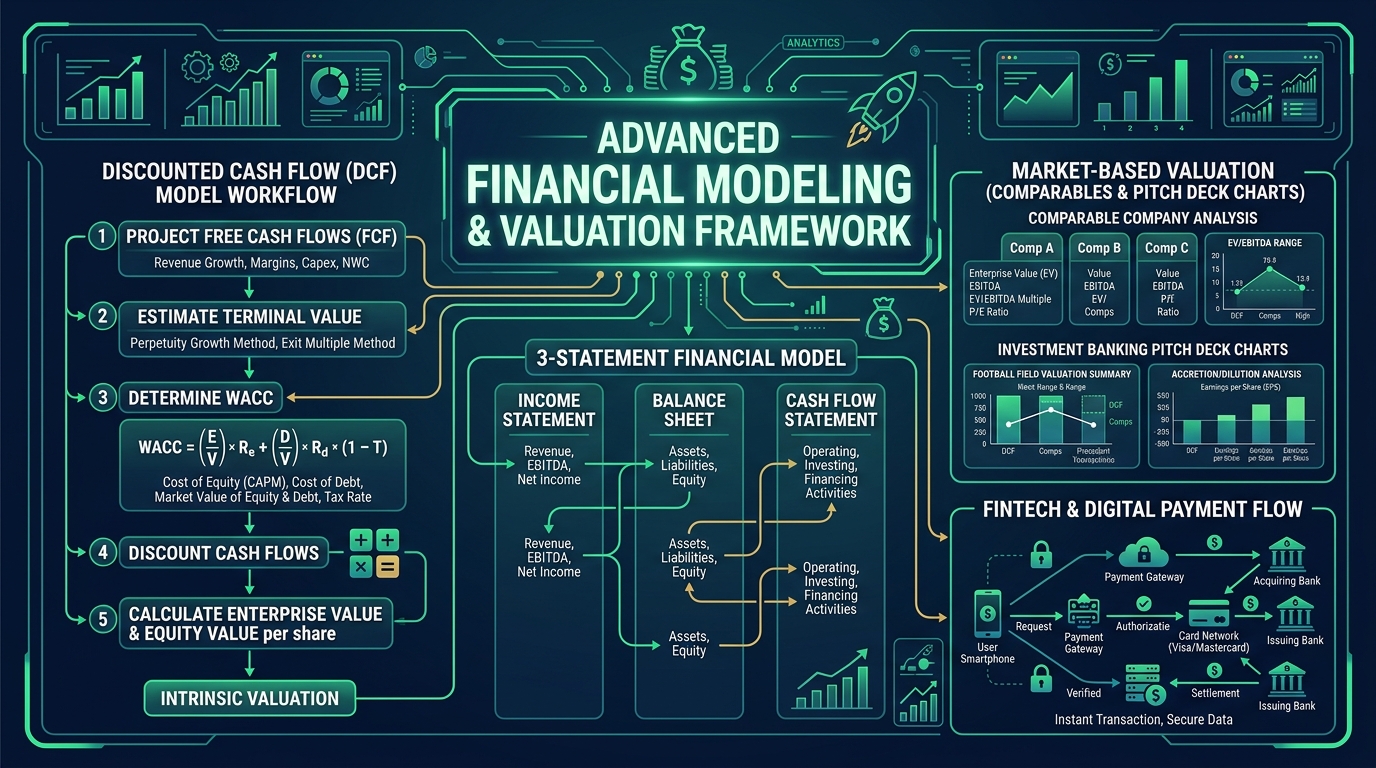
The Three-Statement Linkage Walkthrough
The most common opener: "If depreciation increases by 10, what happens to the statements?"
- Income statement: depreciation up by 10 lowers pre-tax income by 10; at a 25% tax rate net income falls by 7.5
- Cash flow statement: start from net income (down 7.5), add back non-cash depreciation (+10), so cash from operations rises by 2.5
- Balance sheet: cash up 2.5, PP&E down 10, so assets fall 7.5; retained earnings down 7.5, so both sides balance
- Always finish by confirming the balance sheet still balances
Valuation Methodology Map
Choose and justify the right lens for the company being discussed.
- DCF: intrinsic value from projected free cash flows discounted at WACC plus a terminal value
- Trading comparables: relative value from peer multiples such as EV/EBITDA and P/E
- Precedent transactions: value implied by past acquisitions, including a control premium
- Sum of the parts and LBO analysis for conglomerates and financial sponsor scenarios
DCF and Enterprise vs Equity Value
The calculations and logic that every banking interview tests.
Free Cash Flow, WACC and Terminal Value
Unlevered free cash flow = EBIT x (1 - tax rate) + depreciation and amortization - capital expenditure - increase in net working capital. WACC blends the cost of equity (often from CAPM: risk-free rate + beta x equity risk premium) and the after-tax cost of debt, weighted by capital structure. Terminal value is computed with the Gordon Growth method or an exit multiple and often represents well over half of total value, so sensitivity tables on WACC and growth are essential.
UFCF = EBIT(1 - t) + D&A - CapEx - ΔNWC
Cost of Equity = Rf + β × ERP
TV (Gordon) = FCF_n × (1 + g) / (WACC - g)
Equity Value = Enterprise Value - Net Debt - Minority Interest + Cash adjustments
Which Multiples for Which Industry
EV/EBITDA suits most operating businesses because it is capital-structure neutral. P/E is common for banks, with P/B and ROE used for financials because debt is their raw material. EV/Revenue is used for high-growth companies without profits, and EV/EBITDAR for lease-heavy sectors. Match multiple numerator and denominator: enterprise value pairs with pre-interest metrics, equity value with post-interest metrics.
M&A Mechanics and Market Awareness
Show you can think like a deal team member.
Accretion and Dilution in One Minute
A cash or debt-funded acquisition is accretive to acquirer EPS when the target's earnings yield exceeds the after-tax cost of financing. In a stock deal, compare the acquirer P/E to the target P/E: if the acquirer has the higher P/E, the deal is typically accretive. Synergies, purchase accounting adjustments and new share issuance modify the final result.
Preparing a Deal Discussion
Pick two recent transactions in sectors you like. For each, know the buyer, target, size, rationale, valuation multiple, financing and whether you think the price was fair. Also follow indices, RBI policy and one sector deeply so you can discuss pitch ideas with conviction.
Real Interview Questions & Model Responses
Verbatim interview questions asked at top employers with structured thought frameworks and scoring criteria.
Walk me through a DCF.
- Keep to a crisp end-to-end flow before going into detail.
- Mention the cross-check and sensitivity to show judgment.
Why investment banking, and why this bank?
- Support motivation with a concrete experience.
- Show you understand the demanding nature of the job.
Critical Mistakes That Cause Immediate Rejections
- ×Memorizing formulas without being able to explain the intuition.
- ×Mismatching enterprise value with equity-level metrics in multiples.
- ×Having no view on recent deals or markets when asked "what is happening in the market?"
- ×Giving generic reasons such as "I like finance" for the why-banking question.
- ×Getting flustered by a wrong answer instead of recovering by reasoning aloud.
Actionable 30-Day Preparation Checklist
- Master accounting basics and rehearse five three-statement impact questions daily.
- Build a DCF and a comps analysis in Excel for a listed Indian company.
- Learn LBO fundamentals: sources and uses, debt paydown and IRR drivers.
- Follow Economic Times, Mint and Bloomberg Quint daily and note two deals per week.
- Prepare two stock pitches with thesis, valuation and risks.
- Practice walkthrough answers aloud with a timer until each is under two minutes.
- Prepare tailored why-this-firm answers using recent deals the firm advised.
Frequently Asked Questions
Do I need a finance degree to get into investment banking?
No. Many analysts come from engineering and other backgrounds, but you must demonstrate strong accounting and valuation knowledge through courses, internships or self-built models.
Which certifications help for investment banking?
CFA Level 1 or modeling courses such as those from reputed training providers show commitment, but interviewers care more about your ability to answer technical questions and discuss deals.
How long are investment banking interviews?
The process typically includes a resume screen, one or two rounds of technical and fit interviews with analysts and associates, and a final round with senior bankers, sometimes with a modeling test.