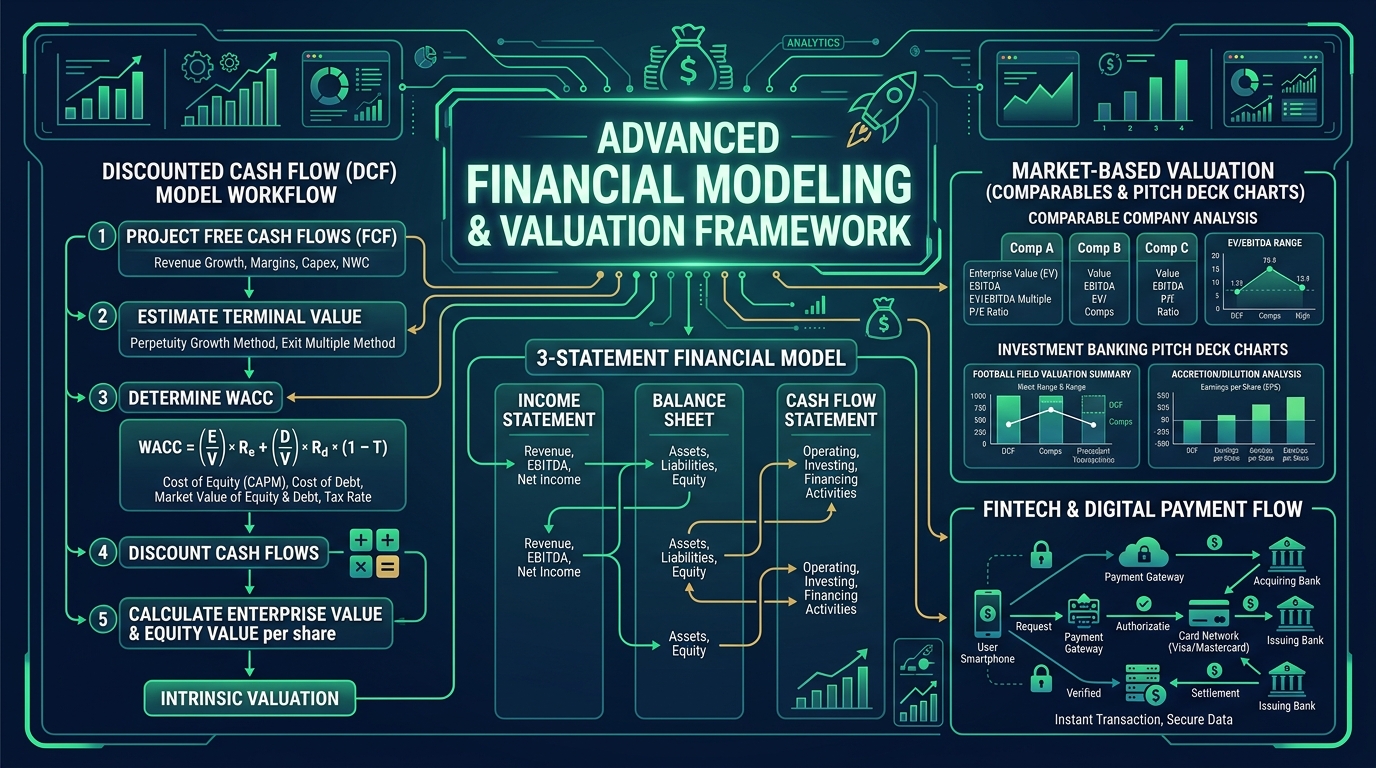
BFSI & Corporate Finance: Financial Modeling, DCF Valuations, Risk & FinTech
From 3-statement models, WACC calculations, and LBO mechanics to Basel III risk compliance and modern FinTech payments.
Executive Overview & Industry Landscape
Corporate Finance, Banking, and FinTech demand precision in financial accounting, corporate valuation methodologies, risk modeling, and regulatory compliance. Candidates must bridge traditional valuation mechanics (Discounted Cash Flow, Comparable Company Analysis, Precedent Transactions) with the rapid digitisation of payment rails, open banking APIs, and algorithmic credit underwriting.
Core Methodology & Strategic Frameworks
The 3-Statement Financial Modeling Linkage
How changes in one financial statement cascade across the balance sheet and cash flow.
- Income Statement: Revenue -> COGS -> Gross Profit -> SG&A -> Operating Income (EBIT) -> Interest & Taxes -> Net Income
- Cash Flow Statement: Net Income flows into Cash Flow from Operations (CFO), adjusted for non-cash Depreciation/Amortization and Working Capital changes
- Balance Sheet Reconciliation: Ending Cash from Cash Flow Statement links to Balance Sheet Cash; Net Income minus Dividends flows into Retained Earnings
Discounted Cash Flow (DCF) & Cost of Capital (WACC)
Calculating intrinsic enterprise value based on projected future unlevered free cash flows.
- Unlevered Free Cash Flow (UFCF) = EBIT x (1 - Tax Rate) + D&A - Capital Expenditures (CapEx) - Δ Net Working Capital (NWC)
- Weighted Average Cost of Capital: WACC = (E/V x Ke) + (D/V x Kd x (1 - Tax Rate))
- Cost of Equity (CAPM): Ke = Risk-Free Rate (Rf) + Beta (β) x Equity Risk Premium (ERP)
- Terminal Value: Gordon Growth Model vs Exit Multiple Method
Financial Risk Management (Market, Credit & Operational Risk)
The regulatory and quantitative pillars governing modern banking solvency.
- Credit Risk: Expected Loss = Probability of Default (PD) x Loss Given Default (LGD) x Exposure at Default (EAD)
- Market Risk: Value at Risk (VaR) at 99% confidence interval across 1-day and 10-day holding periods
- Basel III Capital Adequacy: Capital Adequacy Ratio (CAR) > 11.5% with Tier 1 common equity buffers
Investment Banking Valuation Methodologies & The Football Field
Triangulating company valuation across intrinsic and market-based benchmarks.
Trading Comps vs Precedent Transactions vs DCF
Valuation is never a single number; it is a range visualized in a Football Field chart. Trading Comps (EV/EBITDA, P/E) reflect current public market pricing. Precedent Transactions reflect historical M&A prices including a Control Premium (typically 20-30% above unaffected share price). DCF provides intrinsic value independent of irrational market swings.
- Enterprise Value (EV) = Equity Value + Total Debt + Preferred Stock + Minority Interest - Cash & Cash Equivalents.
- Why EV/EBITDA is preferred: Capital structure neutral, allowing comparison between levered and unlevered competitors.
Real Interview Questions & Model Responses
Verbatim interview questions asked at top employers with structured thought frameworks and scoring criteria.
Walk me through the impact of a $100 Capital Expenditure funded with 50% Debt and 50% Cash on all three statements at year 0 and year 1 (assume 10% straight-line depreciation, 20% tax rate).
- CapEx does not flow through the Income Statement initially.
- Tax shield from depreciation creates a positive cash flow impact.
- Always reconcile both sides of the Balance Sheet.
Critical Mistakes That Cause Immediate Rejections
- ×Mixing up Enterprise Value (EV) and Equity Value when dividing by metrics (e.g. EV/Net Income is mathematically invalid; Net Income belongs to equity holders, so use P/E).
- ×Forgetting to subtract cash when calculating Enterprise Value from Equity Value.
- ×Treating FinTech solely as app design without understanding payment gateways, interchange fees, and regulatory risk.
Actionable 30-Day Preparation Checklist
- Build a dynamic 3-statement financial model in Excel from scratch.
- Memorize WACC, CAPM, and Unlevered Free Cash Flow formulas.
- Practice 10 accounting transaction flows across all three statements.
- Understand the difference between UPI, NEFT, RTGS, and card networks (Visa/Mastercard interchange).
- Read recent earnings releases and 10-K filings of top banks.
Frequently Asked Questions
Why do we use Unlevered Free Cash Flow instead of Levered FCF in DCF?
Unlevered FCF is capital structure neutral—it represents cash available to all capital providers (both debt and equity holders). It is discounted by WACC to calculate Enterprise Value.