Behavioral Bank: 100+ STAR Method Structured Answers for Top Tech & Corporate HR
The master behavioral interview question repository with battle-tested frameworks across Leadership, Conflict Resolution, Project Failures, and High-Pressure Delivery.
Executive Overview & Industry Landscape
Behavioral interview questions ("Tell me about a time when...") are rooted in the psychological premise that past performance is the most reliable predictor of future behavior. Companies like Amazon (with its 16 Leadership Principles), Google (Googliness), and top multinationals reject thousands of technically proficient candidates due to poor behavioral alignment. Mastering the STAR (Situation, Task, Action, Result) methodology transforms vague storytelling into compelling evidence of high-impact leadership.
Core Methodology & Strategic Frameworks
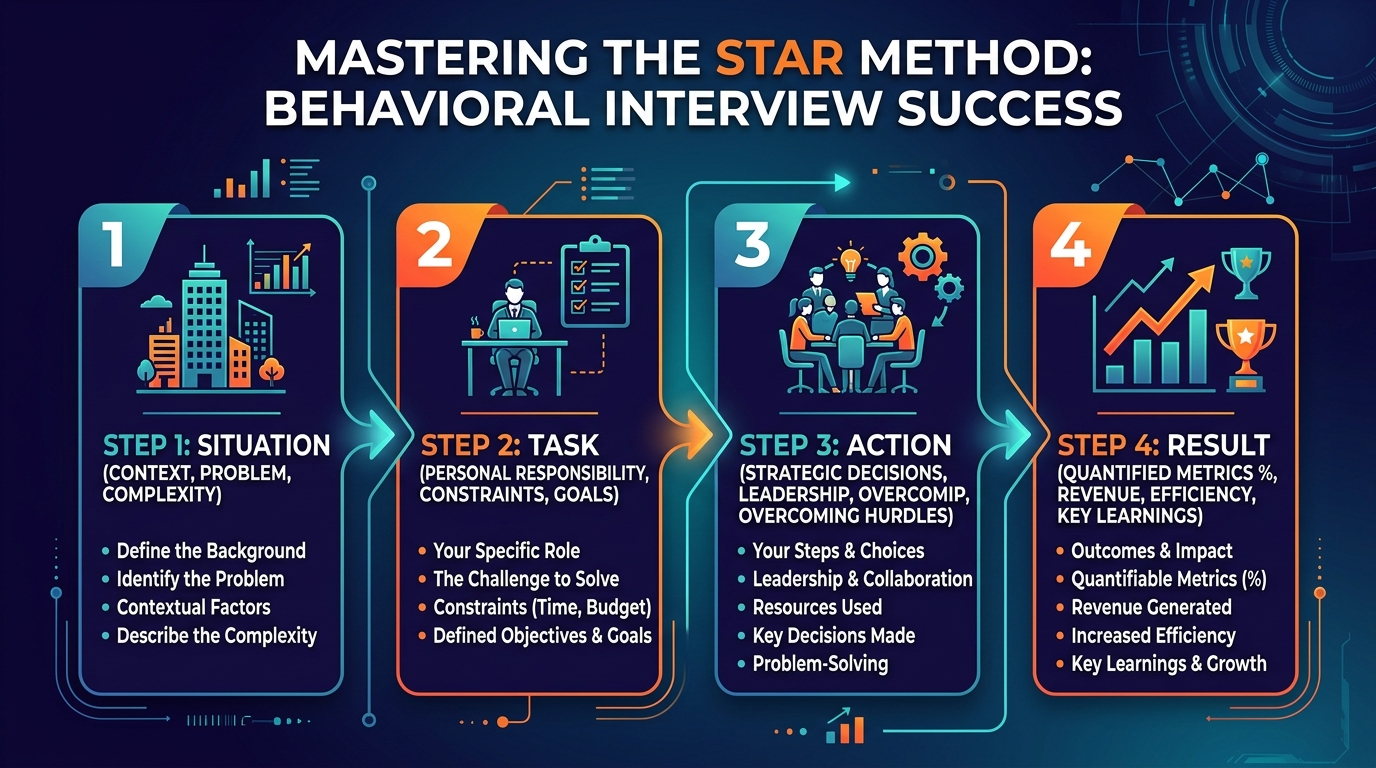
The STAR Method Deconstructed
The golden formula for answering behavioral interview questions concisely within 2 to 3 minutes.
- Situation (15-20% time): Set the scene, explain the company context, the business stakes, and the specific challenge faced
- Task (10-15% time): Define YOUR explicit responsibility and constraints (tight deadlines, limited budget, team attrition)
- Action (50-60% time): The critical core! What specific steps did YOU take? (Avoid saying "we", focus on "I decided", "I engineered", "I negotiated")
- Result (15-20% time): Quantifiable business outcomes (e.g. 35% latency drop, $250k saved, zero production downtime) and key leadership reflection
The 4 Core Behavioral Competency Pillars
Preparing versatile personal stories that can adapt to over 100 variations of behavioral prompts.
- Pillar 1: Leadership, Ownership & Initiative (Taking charge when nobody asked you to)
- Pillar 2: Conflict Resolution & Disagree and Commit (Handling disagreements with engineering leads, product managers, or clients)
- Pillar 3: Overcoming Failures, Mistakes & Adversity (Owning a critical production outage or missed target with complete transparency)
- Pillar 4: Delivering Results Under Extreme Pressure & Tight Deadlines (Prioritization, triaging features, ruthless execution)
Battle-Tested STAR Model Answers: Word-for-Word Breakdowns
Exemplary interview responses illustrating precise time allocation and quantifiable results.
1. Conflict Resolution: "Tell me about a time you had a significant disagreement with a senior colleague or manager."
Situation: At my previous company, our lead architect proposed migrating our transaction processing pipeline to a complex graph database 6 weeks prior to Black Friday. I believed the migration introduced massive operational risk to our checkout stability. Task: As the senior backend engineer, my responsibility was not to cause friction, but to protect platform stability while constructively evaluating architectural alternatives. Action: Instead of emotional arguing, I gathered quantitative performance data. Over the weekend, I built a benchmark harness comparing our tuned Postgres schema against the proposed graph database under our simulated peak 15,000 RPS traffic. The benchmarks showed the graph DB suffered 300ms tail latency spikes under heavy concurrent writes. I scheduled a 1-on-1 meeting with the architect, presented the benchmark graphs objectively, validated his long-term vision, but proposed delaying the migration to Q1 while implementing localized connection pooling immediately. Result: The architect agreed. Our platform survived Black Friday with 100% uptime and zero dropped orders, generating $4.2M in sales. In Q1, we executed the migration cleanly with dedicated load testing.
2. Ownership & Overcoming Failure: "Tell me about a time you made a major mistake or project failed."
Situation: During an urgent hotfix release on a Friday afternoon, I deployed an untested database migration script that inadvertently locked our user authentication table. Task: The outage locked out 50,000 active users from our mobile banking app, causing an immediate Sev-1 outage. Action: I immediately notified our incident response team and owned the mistake without finger-pointing. I terminated the blocking lock query, rolled back the deployment within 8 minutes, and verified auth recovery. Over the weekend, I authored a comprehensive blameless post-mortem document analyzing the root cause. I designed an automated CI/CD guardrail that now runs database lock-detection linters on every pull request, preventing Friday deployments without VP approval. Result: In the 18 months since, zero lock-related deployment incidents have occurred across our entire engineering division.
Real Interview Questions & Model Responses
Verbatim interview questions asked at top employers with structured thought frameworks and scoring criteria.
Tell me about a time you had to deliver a high-stakes project with ambiguous requirements and tight deadlines.
- Demonstrate Bias for Action when data is incomplete.
- Communicate proactively with cross-functional stakeholders.
Critical Mistakes That Cause Immediate Rejections
- ×Using the collective pronoun "We did this, we built that" instead of "I owned, I proposed, I coded".
- ×Spending 80% of the time describing the Situation, leaving only 30 seconds for the Action and Result.
- ×Giving a fake failure ("My biggest mistake is I work too hard and care too much"). Interviewers hate this; share a genuine mistake and show how you matured.
- ×Failing to provide numeric metrics in the Result section.
Actionable 30-Day Preparation Checklist
- Write down 5 core career stories in a STAR bullet matrix.
- Ensure each story has a specific metric (percentage improvement, revenue, hours saved).
- Practice speaking each STAR answer in under 2 minutes and 30 seconds.
- Map your stories to Amazon's 16 Leadership Principles or equivalent corporate core values.
Frequently Asked Questions
How long should a STAR method answer be?
The ideal duration is between 2 and 2.5 minutes. Any shorter lacks depth; any longer risks losing the interviewer's attention.