Software & Systems: System Design (LLD & HLD), DSA Patterns, DevOps & Security
The comprehensive engineering master blueprint for cracking Staff & Senior Software Engineer interviews across Tier-1 tech, unicorns, and top product firms.
Executive Overview & Industry Landscape
Modern software engineering interviews have fundamentally evolved from algorithmic regurgitation to practical, high-throughput architectural trade-offs. Senior candidates are evaluated on their ability to design systems that handle millions of requests per second (RPS), maintain sub-100ms latency, guarantee data consistency under network partitions (CAP theorem), and ensure zero-trust security postures.
Core Methodology & Strategic Frameworks
The 4-Stage High-Level Design (HLD) Blueprint
A disciplined 45-minute structured approach used by Staff Engineers to decompose ambiguous architectural requirements.
- Requirement Clarification & SLA Scoping: Functional vs Non-Functional (Read/Write ratios, Availability % 99.99%, P99 Latency < 100ms)
- Back-of-Envelope Capacity Estimation: QPS calculations, storage projections over 5 years, network bandwidth ingress/egress
- Core API Definition & Data Modeling: REST/gRPC endpoints, SQL vs NoSQL schema design, indexing strategies, primary keys
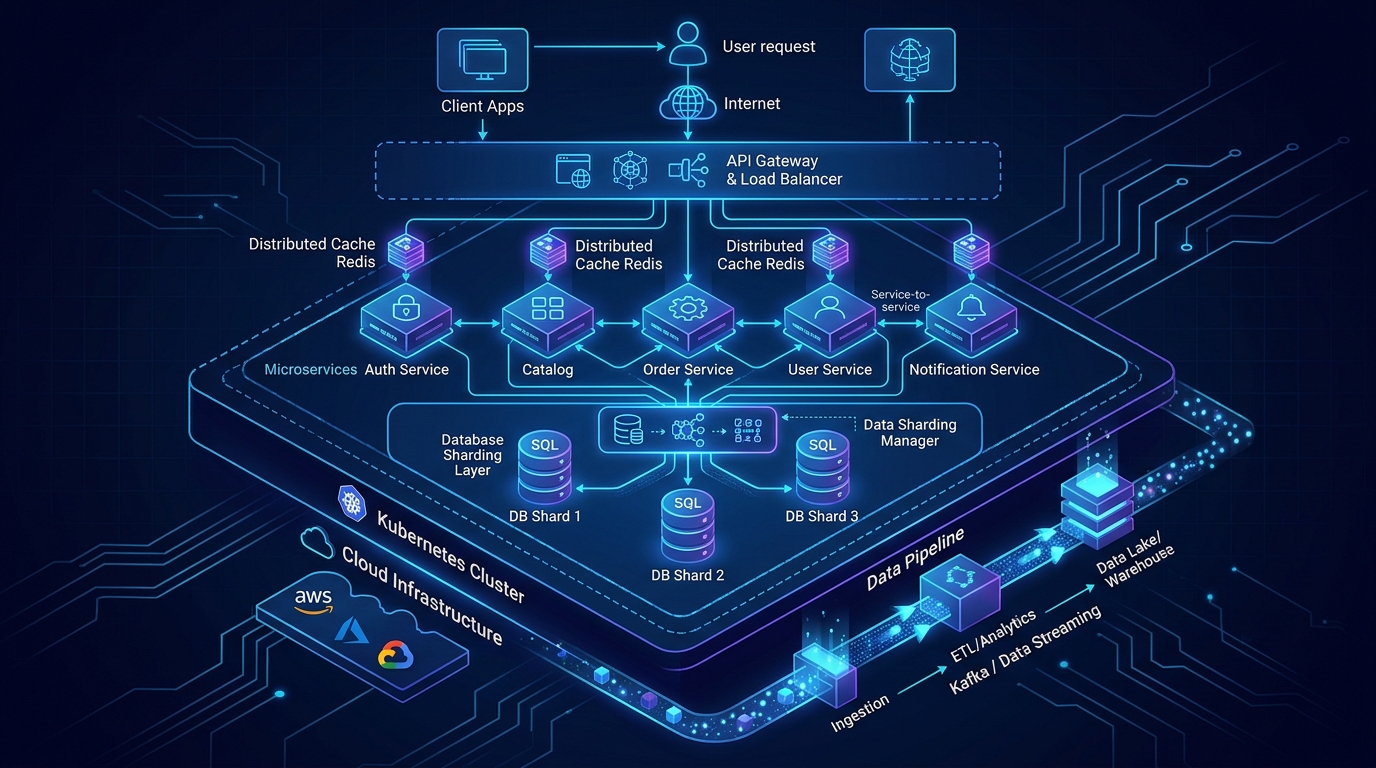
- Component Deep Dive & Bottleneck Mitigation: Distributed cache eviction policies, load balancing (L4 vs L7), message broker queueing, database sharding & read replicas
Object-Oriented Low-Level Design (LLD) Mastery
Translating business logic into robust, extensible code using SOLID principles and GoF design patterns.
- SOLID Foundations: Single Responsibility, Open-Closed, Liskov Substitution, Interface Segregation, Dependency Inversion
- Creational Patterns: Factory Method, Abstract Factory, Singleton with Double-Checked Locking
- Structural & Behavioral: Adapter, Decorator, Strategy, Observer, Command, State pattern for workflow state machines
Essential DSA Patterns for Coding Interviews
Categorizing 2,000+ LeetCode problems into 14 reusable algorithmic mental models.
- Two Pointers & Sliding Window: Array substrings, trapping rainwater, palindrome checks
- Fast & Slow Pointers (Floyd Cycle): Linked list cycles, midpoint detection
- Monotonic Stack & Queue: Next greater element, daily temperatures, sliding window maximum
- Topological Sort & Graph BFS/DFS: Course scheduling, alien dictionary, connected components
- Dynamic Programming & Bitmasking: 0/1 Knapsack, Longest Common Subsequence, interval scheduling
Distributed System Architecture & Scalability Patterns
Detailed analysis of architectural building blocks required for ultra-reliable scale.
1. Load Balancing: Layer 4 vs Layer 7 & Consistent Hashing
Layer 4 load balancers (e.g. AWS NLB, HAProxy TCP mode) route packets based on IP and port without inspecting payload, delivering ultra-low overhead (>1M QPS). Layer 7 load balancers (e.g. NGINX, Envoy, AWS ALB) inspect HTTP headers, cookies, and URI paths, enabling smart path-based routing and SSL termination. Consistent Hashing solves the rehashing catastrophe when scaling cache servers from N to N+1 nodes. By mapping both nodes and keys to a 360-degree virtual ring, adding or removing a node only redistributes K/N keys rather than invalidating the entire cache.
Index = Hash(Key) % Hash_Ring_Size // With Virtual Nodes: Hash(Node_IP + "#" + Virtual_Index)
- Virtual Nodes: Mitigate hot spots by assigning 100-200 virtual tokens per physical node.
- Heartbeat Checks: Active gossip protocols detect node failures within 2-3 seconds.
- Session Stickiness: Avoid stateful session affinity in favor of distributed JWT or external Redis session stores.
2. Database Sharding, Partitioning & The CAP/PACELC Trade-Off
When a single database instance hits CPU, I/O, or storage limits (>2TB), horizontal partitioning (sharding) becomes non-negotiable. Sharding by user_id or tenant_id divides data across multiple database instances. Under the PACELC theorem: If there is a Partition (P), how does your system trade off Availability (A) versus Consistency (C); Else (E), when the system runs normally without partitions, how do you trade off Latency (L) versus Consistency (C)?
- Range-based Sharding: Simple but leads to hotspotting on recent sequential timestamps.
- Hash-based Sharding: Uniform distribution across nodes, though cross-shard joins become costly.
- Directory-based Sharding: Dynamic mapping lookup service, but adds a lookup network hop.
Cloud Infrastructure, Kubernetes Operators & DevSecOps
Modern production systems require automated infrastructure as code (IaC), container orchestration, and multi-region resilience.
Kubernetes Production Architecture & Custom Operators
In production Kubernetes (EKS/GKE), workloads are decoupled across Control Plane (API Server, etcd, Controller Manager, CoreDNS) and Worker Nodes (Kubelet, Kube-proxy, Containerd). Custom Resource Definitions (CRDs) and Operators automate stateful operational tasks like database backups, failovers, and auto-scaling based on custom Prometheus metrics rather than simple CPU thresholds.
- Pod Disruption Budgets (PDB): Ensure minimum healthy pods during cluster node upgrades.
- Horizontal Pod Autoscaler (HPA): Scale on custom business metrics (e.g. SQS queue length or incoming HTTP QPS).
- Service Mesh (Istio/Linkerd): Mutual TLS (mTLS), distributed tracing, and traffic shadowing without code modification.
Zero-Trust Cybersecurity & OWASP Top 10 Mitigation
Modern enterprise systems operate on the principle of "Never Trust, Always Verify". Key defensive pillars include OpenID Connect (OIDC) JWT validation, fine-grained Role-Based Access Control (RBAC), Secrets Management via HashiCorp Vault or AWS Secrets Manager with automated key rotation, and automated static/dynamic vulnerability scanning in CI/CD pipelines.
- SQL Injection Prevention: Parameterized queries and ORM prepared statements.
- Distributed Denial of Service (DDoS): Cloudflare / AWS Shield rate limiting at edge CDN.
- Cross-Site Scripting (XSS): Content Security Policy (CSP) headers and input sanitization.
Real Interview Questions & Model Responses
Verbatim interview questions asked at top employers with structured thought frameworks and scoring criteria.
Design a globally distributed URL Shortener service like Bitly handling 100 Million daily active users.
- Base62 encoding avoids collisions compared to naive MD5 truncation.
- Snowflake ID eliminates single-point-of-failure counter bottlenecks.
- Read-to-write ratio of 10:1 demands robust Redis caching.
Explain how you would debug a high P99 latency spike in a microservice application deployed on AWS EKS.
- Never guess; trace from API gateway downstream.
- Check Kubernetes CPU limits (cgroups CFS throttling can cause 50-200ms latency spikes).
- Review database connection pool saturation.
Critical Mistakes That Cause Immediate Rejections
- ×Jumping straight into drawing boxes without clarifying non-functional requirements or calculating QPS/storage capacity.
- ×Suggesting SQL joins across distributed microservices instead of event-driven asynchronous data aggregation.
- ×Treating caching as an afterthought without explaining cache stampede, cache penetration, or eviction policies (LRU/LFU).
- ×Over-engineering with blockchain or microservices for simple low-throughput CRUD apps where a modular monolith suffices.
Actionable 30-Day Preparation Checklist
- Review top 10 System Design architectures: URL Shortener, Twitter/X Newsfeed, Uber Ride Matching, WhatsApp/Slack Chat, YouTube/Netflix Video Streaming, Rate Limiter.
- Practice drawing clear architectural diagrams on Miro or Excalidraw within 35 minutes.
- Master the 14 DSA patterns and solve 2 LeetCode Medium/Hard problems daily under a 25-minute timer.
- Review GoF design patterns in your primary language (Java, Go, TypeScript, or Python).
- Be prepared to explain every line on your resume: scale numbers, latencies, concurrency locks, and failure modes.
Frequently Asked Questions
How much coding vs system design is expected in senior engineer interviews?
For Senior (SDE-2 / SDE-3) positions at Tier-1 companies, the typical loop consists of 2 Coding/DSA rounds, 2 System Design rounds (1 High-Level Design + 1 Low-Level Design), and 1 Behavioral/Bar-Raiser round.
Which database should I default to in System Design rounds: SQL or NoSQL?
Neither by default. Justify your choice based on access patterns: Choose Relational SQL (Postgres/MySQL) if you require strict ACID compliance, complex relational queries, or financial transactions. Choose NoSQL (DynamoDB, Cassandra, MongoDB) for massive horizontal scale, high write throughput, unstructured data, and predictable key-value lookups.