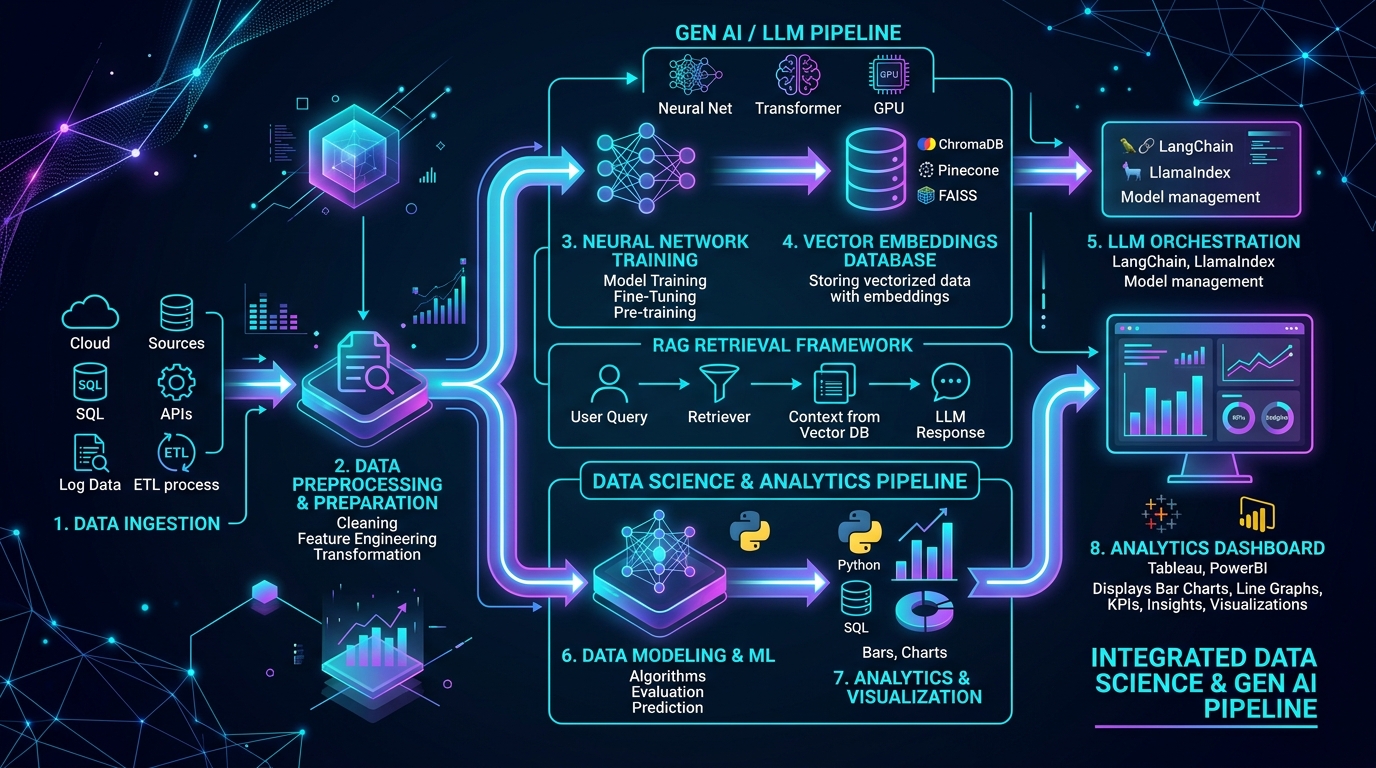
Generative AI & ML Engineer Interview Guide: LLMs, RAG, Evaluation and MLOps
Master machine learning fundamentals, transformer concepts, retrieval-augmented generation, fine-tuning trade-offs and production MLOps for AI engineer interviews.
Executive Overview & Industry Landscape
AI engineering interviews have split into two overlapping tracks: classical ML (statistics, feature engineering, model selection, metrics) and applied generative AI (LLMs, retrieval, agents, evaluation and cost control). Strong candidates show they can move from a notebook to a monitored production service. Interviewers care less about reciting paper names and more about whether you choose the simplest approach that works, measure it properly and understand failure modes such as hallucination, drift and data leakage.
Core Methodology & Strategic Frameworks
The Prompt, RAG, Fine-tune Decision Ladder
A defensible order of escalation when asked how to adapt an LLM to a business problem.
- Start with prompting and structured output: cheapest, fastest to iterate, no training data needed
- Add retrieval (RAG) when the model needs fresh, private or citable knowledge that changes often
- Fine-tune when you need consistent style, format or domain behavior that prompting cannot reliably achieve, and you have quality labeled examples
- Combine approaches only after measuring that the simpler step is insufficient on a held-out evaluation set
End-to-End ML Project Framework
Structure for any "walk me through an ML project" question.
- Problem framing: business metric, ML metric, baseline and success threshold
- Data: sourcing, labeling quality, leakage checks, train/validation/test split that respects time
- Modeling: simple baseline first, then iterate; track experiments
- Evaluation: metrics matched to cost of errors (precision, recall, F1, AUC, calibration), error analysis by segment
- Deployment and monitoring: latency, throughput, data drift, concept drift, retraining triggers
Transformers and LLM Concepts You Will Be Asked
Concise, accurate explanations that satisfy both ML and engineering interviewers.
Attention, Tokens and Context Windows
Self-attention lets each token weigh every other token in the sequence by computing queries, keys and values; the attention score is softmax(QK^T / sqrt(d_k)) applied to V. Multi-head attention runs several of these in parallel to capture different relationships. Text is split into tokens by a subword tokenizer, and cost and latency scale with token count. The context window is the maximum number of tokens the model can attend to; attention cost grows quadratically with sequence length in the standard formulation, which is why long-context optimizations matter.
Attention(Q, K, V) = softmax( Q K^T / sqrt(d_k) ) V
Designing a RAG System
A typical pipeline chunks documents, creates embeddings, stores them in a vector index, retrieves top-k candidates for a query, optionally reranks them, and passes the best context to the LLM with an instruction to answer only from the provided sources. Quality depends mostly on retrieval: chunk size and overlap, metadata filters, hybrid search (keyword plus vector) and reranking. Evaluate retrieval separately (recall@k, MRR) from generation (faithfulness, answer relevance).
- Hallucination mitigation: grounding, citations, refusal when context is insufficient, output validation
- Security: prompt injection through retrieved documents, access control on the index, PII redaction
- Cost control: caching, smaller models for simple queries, prompt compression
Classical ML Essentials & MLOps
Fundamentals that remain core in every ML engineer loop.
Bias-Variance, Regularization and Metrics
High bias means underfitting (model too simple); high variance means overfitting (model memorizes noise). Regularization (L1 encourages sparsity, L2 shrinks weights), more data, early stopping and dropout reduce variance. For imbalanced classes, accuracy is misleading; use precision-recall curves, F1 and choose a threshold from business cost. Cross-validation estimates generalization, but for time series use forward-chaining splits to avoid leakage.
- Precision = TP / (TP + FP); Recall = TP / (TP + FN)
- Data leakage is the most common reason a model looks excellent offline and fails in production
Deploying and Monitoring Models
Package the model with its preprocessing in a versioned artifact, serve behind an API with batching and timeouts, and roll out with shadow or canary traffic. Monitor input distribution drift, prediction distribution, latency, error rate and, where labels arrive later, live accuracy. Automate retraining pipelines with data validation, and keep a model registry for traceability and rollback.
Real Interview Questions & Model Responses
Verbatim interview questions asked at top employers with structured thought frameworks and scoring criteria.
Your RAG chatbot gives confident but wrong answers. How do you diagnose and fix it?
- Always split retrieval metrics from generation metrics.
- A fixed evaluation set is what turns opinions into engineering.
When would you fine-tune a model instead of using RAG?
- Knowledge belongs in retrieval; behavior belongs in fine-tuning.
- Justify the choice with evaluation data.
Critical Mistakes That Cause Immediate Rejections
- ×Naming trendy frameworks without being able to explain the underlying mechanism.
- ×Skipping a baseline and jumping directly to complex models.
- ×Evaluating only with a handful of hand-picked demo prompts.
- ×Ignoring cost, latency and safety when proposing an LLM solution.
- ×Not discussing data leakage or train/serving skew in ML project walkthroughs.
Actionable 30-Day Preparation Checklist
- Implement logistic regression, k-means and a decision tree from scratch to cement fundamentals.
- Build one RAG application with an evaluation set of at least 30 question-answer pairs.
- Revise probability, linear algebra basics, gradient descent and common loss functions.
- Practice explaining attention, embeddings and tokenization in plain language.
- Deploy a model behind a REST API with Docker and add basic monitoring.
- Prepare one case study on handling an imbalanced dataset end to end.
- Read the model cards and API documentation of the LLM providers you list on your resume.
Frequently Asked Questions
Do I need a PhD to become a Generative AI engineer?
No. Applied AI engineering roles value software engineering, evaluation skills and shipped projects. Research scientist roles more often expect advanced degrees.
What is the difference between an ML engineer and a data scientist?
Data scientists focus on analysis, experimentation and modeling to answer business questions. ML engineers focus on building, deploying and maintaining reliable model-powered systems in production.
Which projects impress interviewers most for AI roles?
End-to-end projects with a clear problem, a baseline, a quantitative evaluation, error analysis and a deployed demo are more convincing than many tutorial notebooks.