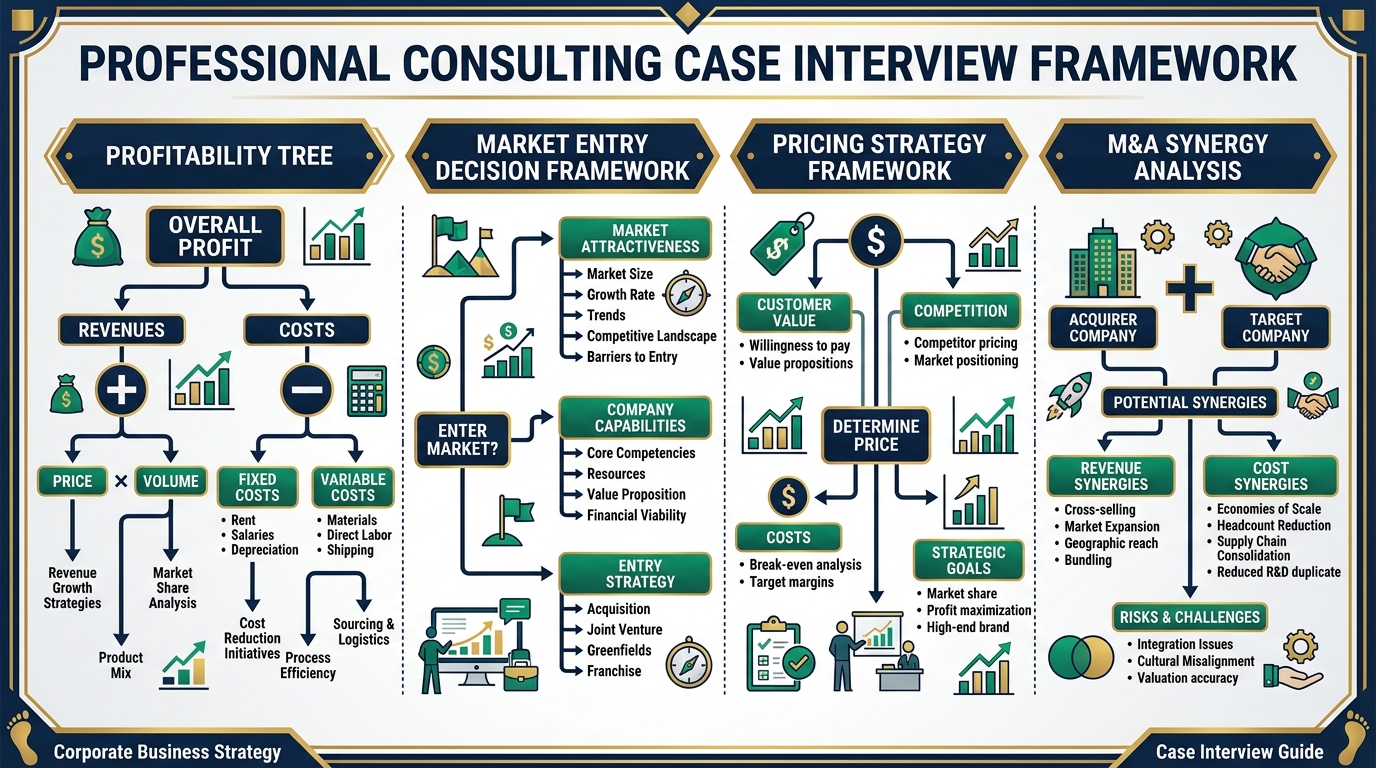
Case Interview Frameworks: Profitability, Market Entry, Pricing & M&A Strategy
The definitive consulting interview playbook for cracking McKinsey, BCG, Bain, Strategy&, and Big 4 management consulting rounds.
Executive Overview & Industry Landscape
Management consulting case interviews simulate high-stakes boardroom advisory engagements. Interviewers do not look for memorized formulaic templates; they assess structured hypothesis-driven thinking, MECE (Mutually Exclusive, Collectively Exhaustive) problem decomposition, mental math speed, commercial acumen, and synthesis under pressure.
Core Methodology & Strategic Frameworks
The MECE Principle & Hypothesis-Driven Problem Solving
The non-negotiable standard for decomposing complex ambiguity without gaps or overlaps.
- Mutually Exclusive: Ensure branches of your issue tree do not overlap or double-count causes
- Collectively Exhaustive: Ensure all plausible root causes or strategic avenues are captured
- Hypothesis Upfront: "Based on our client’s 20% margin decline, my initial hypothesis is that recent raw material cost inflation has outpaced pricing adjustments. I will investigate Revenues then Costs to confirm."
The Profitability Master Tree (Revenues vs Costs)
Diagnosing why a company is losing money and identifying high-leverage turnaround levers.
- Profit = Total Revenues - Total Costs
- Revenue Branch: Price per Unit x Volume (Units Sold) -> Segment by Product Line, Customer Segment, Geography, and Distribution Channels
- Cost Branch: Fixed Costs (Rent, PP&E Depreciation, Overhead, SG&A) vs Variable Costs (Direct Materials, Labor, Sourcing, Logistics)
- Benchmarking: Is the margin erosion company-specific or an industry-wide trend?
The 4-Pillar Market Entry & Expansion Framework
Advising executive leadership on whether and how to enter a new geography, industry, or product vertical.
- Pillar 1: Market Attractiveness (Size, Growth rate %, Cyclicality, Customer Willingness-to-pay, Barriers to entry)
- Pillar 2: Competitive Dynamics (Competitor market share, Fragmentation, Moats, Anticipated retaliation)
- Pillar 3: Company Capabilities & Financials (Core competencies, Capital investment required, Payback period, Breakeven timeline)
- Pillar 4: Mode of Entry (Organic Greenfield build, Mergers & Acquisitions, Joint Venture / Strategic Alliance, Licensing)
Pricing Strategy & M&A Synergy Due Diligence
Advanced strategic frameworks for product monetization and inorganic acquisitions.
The 3 Lenses of Strategic Pricing
When pricing a new innovation (e.g. a revolutionary pharmaceutical drug or enterprise SaaS platform), evaluate three methodologies: 1. Cost-Plus Pricing (Baseline floor, rarely optimal for differentiated products). 2. Competitor-Based Benchmarking (Substitutes, reference price points). 3. Value-Based Pricing (Willingness to pay based on economic value delivered to the customer).
- Economic Value to Customer (EVC): If a software saves a hospital $10M in operational waste annually, a 15-20% fee ($1.5M-$2.0M) represents massive customer ROI.
- Price Elasticity: Calculate percentage change in quantity demanded over percentage change in price.
M&A Synergy Valuation: Revenue vs Cost Synergies
In mergers and acquisitions, deals destroy value when buyers overpay for phantom synergies. Consultants classify synergies into hard Cost Synergies (headcount rationalization, supply chain consolidation, duplicate IT elimination) and soft Revenue Synergies (cross-selling, geographic expansion, bundled pricing).
- Discounting Revenue Synergies: Treat revenue synergies with conservatism; cultural clashes frequently delay cross-sell initiatives.
- Integration Costs: Always budget one-off restructuring and severance costs.
Real Interview Questions & Model Responses
Verbatim interview questions asked at top employers with structured thought frameworks and scoring criteria.
A premier national gym chain with 150 locations has seen profits decline by 25% over the last 18 months despite steady membership numbers. Why, and how would you reverse it?
- State hypothesis before diving into arithmetic.
- Differentiate between core subscription revenue and ancillary spend.
- Always conclude with a recommendation, risks, and next steps.
Critical Mistakes That Cause Immediate Rejections
- ×Reciting the framework name to the interviewer ("I am now going to use the Porter 5 Forces framework"). Tailor the framework organically.
- ×Performing case math silently in your head. Interviewers grade your thought process; write and speak your math out loud.
- ×Getting defensive when challenged by an interviewer. Consulting partners pressure-test candidates to see how they behave in front of Fortune 500 CEOs.
- ×Failing to deliver an executive elevator summary at the conclusion of the case.
Actionable 30-Day Preparation Checklist
- Complete 40+ live mock cases with experienced peers or consulting alumni.
- Practice mental math drills daily: percentage increases, weighted averages, and currency conversions.
- Master the Pyramid Principle (Answer first, followed by supporting arguments).
- Read business news (Wall Street Journal, Financial Times, The Ken) to build commercial intuition.
- Prepare structured stories for the behavioral "Fit" portion (Why consulting? Why McKinsey/BCG?)
Frequently Asked Questions
How fast must mental math be in case interviews?
You should be able to multiply numbers (e.g. 150,000 units x $45/unit) and calculate percentage growth without a calculator within 10-15 seconds while explaining your steps out loud.
What is the Pyramid Principle in consulting?
Developed by Barbara Minto at McKinsey, the Pyramid Principle requires stating the top-line recommendation or conclusion first, followed by three logically structured supporting pillars.