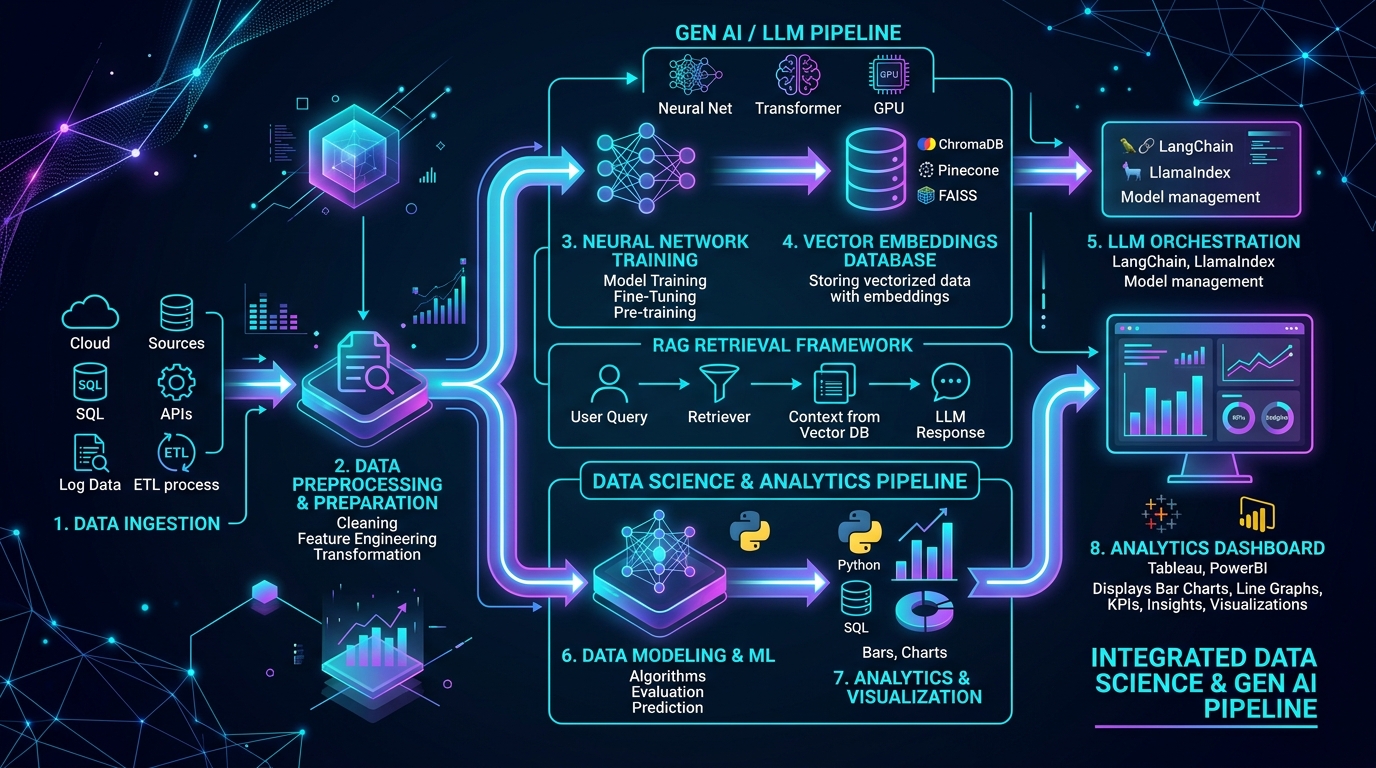
Data Science & AI: Generative AI, LLM Orchestration, ML Engineering & Big Data
From Transformer internals and RAG retrieval pipelines to production ML systems, PyTorch fine-tuning, and scalable SQL/BI data platforms.
Executive Overview & Industry Landscape
The enterprise landscape has pivoted aggressively toward Generative AI, Agentic Workflows, and intelligent data systems. AI Engineers and Data Scientists today must not only understand mathematical foundations (loss functions, gradient descent, self-attention mechanisms) but also deploy production-grade LLM applications using Retrieval-Augmented Generation (RAG), vector databases, Model Context Protocol (MCP), and cost-effective SLM fine-tuning.
Core Methodology & Strategic Frameworks
The Modern RAG (Retrieval-Augmented Generation) Architecture
Overcoming LLM hallucinations and context limitations by feeding grounded enterprise domain data.
- Document Parsing & Chunking: Recursive character splitting, semantic chunking, and parent-child hierarchical indexing
- Dense Vector Embeddings: Text-embedding-3, BGE-large, Cohere multilingual representations
- Vector Indexing & Hybrid Search: HNSW (Hierarchical Navigable Small World) + BM25 keyword matching with cross-encoder re-ranking
- Context Synthesis & Guardrails: PII redaction, prompt injection defense, citation grounding, and evaluation via RAGAS metrics
Agentic Workflows & Model Context Protocol (MCP)
Transforming static LLM chatbots into autonomous problem-solving agents equipped with tools and environments.
- ReAct Loop: Reasoning and Action iteration (Thought -> Action -> Observation -> Final Answer)
- MCP (Model Context Protocol): Standardized protocol for connecting AI models securely to local filesystems, database schemas, and developer toolkits
- Agentic Frameworks: LangGraph, LlamaIndex Workflows, AutoGen, and CrewAI for multi-agent collaboration
Full-Stack Data Analytics Stack (SQL + Python + BI)
The core technical arsenal for Data Analysts and Analytics Engineers driving executive business decisions.
- Advanced SQL Mastery: Window functions (ROW_NUMBER, RANK, DENSE_RANK, NTILE), Common Table Expressions (CTEs), cumulative aggregations
- Python for Data Science: Pandas, NumPy vectorization, Scikit-learn, statistical hypothesis testing (A/B testing, p-values)
- Executive Dashboards: Tableau & PowerBI KPI modeling, DAX formulas, Star Schema data modeling in data lakehouses
Generative AI Internals: Attention Mechanisms & Fine-Tuning
Mathematical intuition and engineering practicalities behind Transformers and parameter-efficient fine-tuning.
Scaled Dot-Product Self-Attention Formula & Multi-Head Attention
The Transformer architecture relies on Self-Attention to compute dependencies between words in parallel. Given Query (Q), Key (K), and Value (V) matrices, attention weights are calculated by taking the dot product of Q and K, dividing by the square root of the dimension (sqrt(d_k)) to prevent vanishing gradients in softmax, and multiplying by V.
Attention(Q, K, V) = Softmax( (Q · K^T) / sqrt(d_k) ) · V
MultiHead(Q, K, V) = Concat(head_1, ..., head_h) · W_O
- Time & Memory Complexity: Vanilla attention is O(N^2) in sequence length; FlashAttention accelerates this via GPU SRAM tiling.
- RoPE (Rotary Position Embedding): Encodes relative token distances seamlessly without fixed sinusoidal tables.
Fine-Tuning Small Language Models (SLMs) with LoRA & QLoRA
Full fine-tuning of 8B-70B models requires immense GPU VRAM. Low-Rank Adaptation (LoRA) freezes the pre-trained model weights W_0 and injects trainable rank decomposition matrices A and B into Transformer layers. QLoRA quantizes the base model to 4-bit NormalFloat (NF4), allowing a 7B parameter model to be fine-tuned on a single consumer 16GB GPU.
W = W_0 + ΔW = W_0 + (B · A) · (α / r)
where r << min(d_in, d_out) (typically r=8 or 16)
- Target Matrices: Usually applied to query_proj, key_proj, value_proj, and out_proj layers.
- Parameter Efficiency: Reduces trainable parameters by >99% with virtually zero loss in task accuracy.
Production Machine Learning Engineering (MLOps) & Big Data Pipelines
Transitioning machine learning models from Jupyter notebooks into automated continuous inference microservices.
Feature Stores, Data Drift & Model Monitoring
Enterprise ML pipelines require consistent features between training and real-time inference to prevent train-serving skew. Feature stores (Feast, Hopsworks) manage point-in-time correct historical features for training while serving sub-10ms lookups via Redis for live inference. Continuous monitoring monitors Population Stability Index (PSI) and Kullback-Leibler (KL) divergence to detect data drift.
- Concept Drift: The statistical relationship between input features and target labels changes over time.
- Data Drift: The distribution of incoming production input features shifts relative to training data.
- Canary Deployments: Route 5% of traffic to new models to benchmark latency and revenue impact.
Real Interview Questions & Model Responses
Verbatim interview questions asked at top employers with structured thought frameworks and scoring criteria.
How do you prevent and evaluate hallucinations in a production RAG system?
- RAGAS metrics (Faithfulness, Answer Relevance, Context Recall) provide quantitative benchmarks.
- Re-ranking reduces context noise from 20 chunks to top 3 high-signal chunks.
- Always log user prompts and model responses for continuous RLHF/DPO dataset curation.
Write a SQL query to calculate the 7-day rolling average revenue and identify users whose transactions exceeded their personal 30-day average by 3x.
- Master ROWS BETWEEN N PRECEDING AND CURRENT ROW frames.
- Partitioning by user ensures memory efficiency on clustered analytical databases.
- Explain execution plan differences between Postgres and distributed engines like Snowflake/BigQuery.
Critical Mistakes That Cause Immediate Rejections
- ×Focusing purely on model accuracy (F1-score/ROC-AUC) while ignoring business metrics, inference latency, and GPU cloud costs.
- ×Assuming bigger LLMs are always better; senior engineers prioritize fine-tuned Small Language Models (SLMs) for latency and data privacy.
- ×Failing to handle chunk boundaries in RAG, which cuts critical sentence meanings in half.
- ×Writing non-vectorized Python for-loops over DataFrames instead of native NumPy/Pandas vectorized operations.
Actionable 30-Day Preparation Checklist
- Implement an end-to-end RAG pipeline from scratch with LangChain/LlamaIndex and ChromaDB.
- Practice 20 complex SQL interview queries featuring multi-level window functions and recursive CTEs.
- Understand attention formulas, RoPE embeddings, FlashAttention, and LoRA rank math.
- Review A/B testing fundamentals: sample size calculation, p-values, Type I vs Type II errors, and Bonferroni correction.
- Prepare a 5-minute technical walkthrough of your best ML/GenAI portfolio project.
Frequently Asked Questions
Should a Data Analyst learn Generative AI and LLM tools?
Yes. Modern Data Analysts are expected to use LLMs for automated code generation, natural language to SQL interfaces (Text-to-SQL), and unstructured text extraction in addition to traditional Tableau/PowerBI dashboards.
What is Model Context Protocol (MCP) and why is it important?
MCP is an open standard introduced by Anthropic that allows AI applications to connect safely and bidirectionally with external developer tools, enterprise databases, and local file structures without writing proprietary one-off connectors.