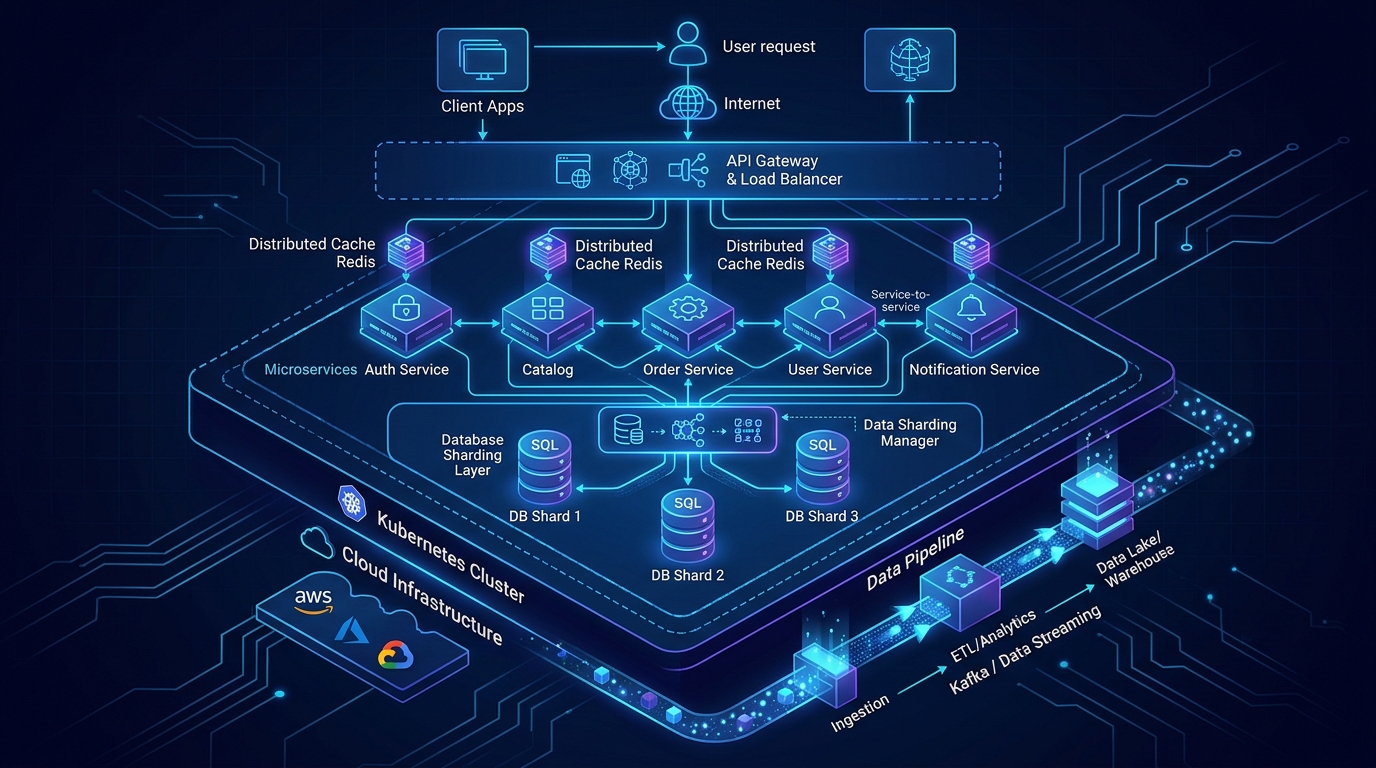
Cloud, DevOps & SRE Engineer Interview Guide: CI/CD, Kubernetes, Terraform & Incident Response
Prepare for DevOps, Cloud and Site Reliability Engineering interviews with pipeline design, container orchestration, infrastructure-as-code and on-call scenario frameworks.
Executive Overview & Industry Landscape
Every product company now depends on automated delivery and reliable infrastructure, which makes DevOps, Cloud and Site Reliability Engineering some of the most consistently hired profiles in India. Interviews blend three things: hands-on tooling fluency (Linux, Git, Docker, Kubernetes, Terraform), systems thinking (networking, scaling, failure modes) and operational judgment (how you behave when production is on fire). This guide gives you the frameworks interviewers use to score each of the three.
Core Methodology & Strategic Frameworks
The CI/CD Pipeline Design Framework
A repeatable structure for answering "design a deployment pipeline for a microservice".
- Source: trunk-based development or short-lived branches, mandatory pull request review, signed commits where required
- Build and test: unit tests, linting, SAST and dependency scanning, container image build with a pinned base image
- Artifact: push an immutable, versioned image to a registry; never rebuild between environments
- Deploy: environment promotion (dev, staging, prod) using rolling, blue-green or canary strategy with automated health checks
- Verify and rollback: smoke tests, SLO-based gate, one-command rollback to the last known good version
SRE Fundamentals: SLI, SLO, Error Budget
The vocabulary Google-style SRE interviews expect you to use fluently.
- SLI: a measured signal of user experience such as request success rate or p99 latency
- SLO: the target for that signal, for example 99.9% of requests succeed over 30 days
- Error budget: 100% minus SLO. When the budget is spent, feature releases slow down and reliability work takes priority
- Toil: manual, repetitive, automatable work. SREs aim to keep toil under roughly 50% of their time
Containers, Kubernetes & Infrastructure-as-Code
The platform concepts that appear in nearly every DevOps technical round.
Kubernetes Objects You Must Explain Without Notes
A Pod is the smallest deployable unit and holds one or more containers sharing network and storage. A Deployment manages ReplicaSets to give declarative rolling updates and rollbacks. A Service gives a stable virtual IP and DNS name to a changing set of Pods. An Ingress routes external HTTP traffic to Services. ConfigMaps and Secrets inject configuration. Liveness probes restart a stuck container; readiness probes remove a Pod from Service endpoints until it is ready. Resource requests drive scheduling while limits cap usage and can trigger OOMKills.
- Debug flow for a CrashLoopBackOff: kubectl describe pod, kubectl logs --previous, check probes, resource limits, config and image tag
- Know the difference between a StatefulSet (stable identity, ordered rollout) and a Deployment
- Explain HPA (scales Pods on metrics) versus Cluster Autoscaler (scales nodes)
Terraform State, Modules and Drift
Terraform describes desired infrastructure declaratively; the state file maps your code to real resources. Store state remotely (for example S3 with DynamoDB locking) so teams cannot corrupt it concurrently. Use modules for reuse, workspaces or separate state per environment for isolation, and run terraform plan in CI so changes are reviewed before apply. Drift occurs when someone changes resources manually; detect it with plan and prevent it with restricted console access.
terraform init
terraform fmt -check
terraform validate
terraform plan -out=tfplan   # reviewed in pull request
terraform apply tfplan       # run by pipeline only
Incident Response & Observability
How to show operational maturity in scenario and on-call rounds.
A Calm Incident Response Playbook
Step 1: Acknowledge and declare severity. Step 2: Mitigate first (rollback, failover, feature flag off) before hunting root cause. Step 3: Communicate on a fixed cadence to stakeholders. Step 4: Confirm recovery with the same SLIs that detected the problem. Step 5: Write a blameless post-mortem with timeline, contributing factors and tracked action items.
- Metrics, logs and traces are the three pillars of observability; alerts should fire on symptoms users feel, not every internal cause
- Use the RED method for services (Rate, Errors, Duration) and USE for resources (Utilization, Saturation, Errors)
Real Interview Questions & Model Responses
Verbatim interview questions asked at top employers with structured thought frameworks and scoring criteria.
Your deployment succeeded but error rates doubled five minutes later. What do you do?
- Mitigate first, root-cause second.
- Close the loop by improving the pipeline, not just fixing the bug.
How would you reduce the cloud bill of a service running on AWS by 30% without hurting reliability?
- Always tie savings to SLOs so reliability is protected.
- Mention guardrails so costs do not creep back.
Critical Mistakes That Cause Immediate Rejections
- ×Listing tools without explaining why you would choose them or what trade-offs they carry.
- ×Rebuilding artifacts per environment instead of promoting one immutable image.
- ×Jumping to root cause during an incident while users are still impacted.
- ×Storing secrets in repositories, environment files or Terraform state.
- ×Having no hands-on lab: interviewers quickly detect candidates who have only read documentation.
Actionable 30-Day Preparation Checklist
- Build a small project: containerize an app, deploy to Kubernetes (kind or minikube) with a CI pipeline in GitHub Actions or GitLab CI.
- Provision a VPC, subnet and virtual machine with Terraform and destroy it cleanly.
- Practice 10 Linux troubleshooting scenarios: disk full, high load, port conflict, DNS failure, permission denied.
- Revise TCP/IP, DNS resolution, TLS handshake and load balancing (L4 vs L7).
- Set up Prometheus and Grafana for a sample service and define one SLO with an alert.
- Write one blameless post-mortem for an outage you simulate yourself.
- Prepare two STAR stories about reliability or automation you drove.
Frequently Asked Questions
What is the difference between DevOps and SRE?
DevOps is a culture and set of practices that unites development and operations through automation and shared ownership. SRE is a specific implementation of those ideas that treats operations as a software problem, using SLOs, error budgets and toil reduction to balance reliability with release velocity.
Do I need a cloud certification to get a DevOps job?
Certifications such as AWS Solutions Architect Associate or CKA help fresher resumes pass screening, but projects and hands-on troubleshooting ability carry more weight in interviews.
Which programming language should a DevOps engineer learn?
Strong Bash plus Python or Go is the common combination. Python is excellent for automation scripts and cloud SDKs, while Go is widely used in cloud-native tooling.