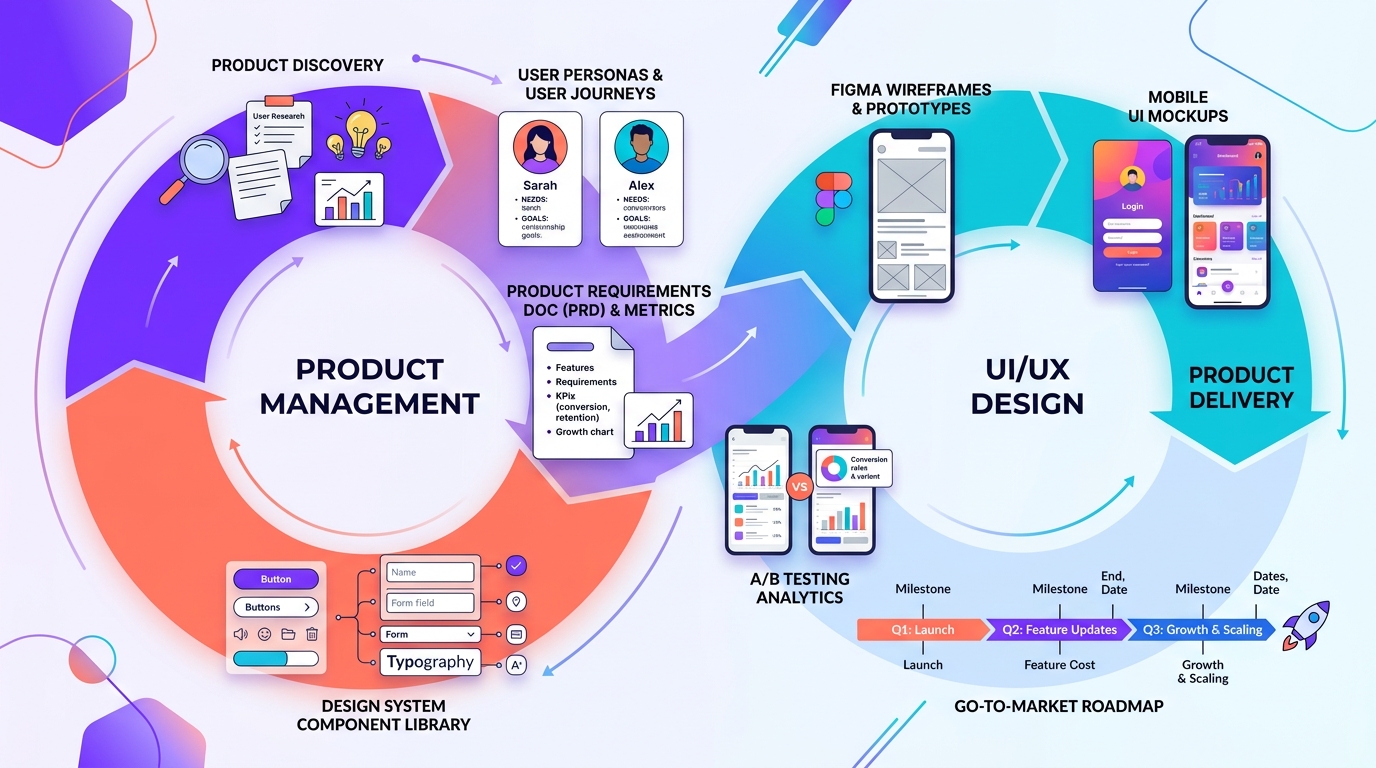
Product & Design: Product Management, Metrics, PRDs, and UI/UX Design Systems
From product sense and North Star metrics to wireframing in Figma, micro-interactions, and portfolio case study defenses.
Executive Overview & Industry Landscape
Product Management and UI/UX Design represent the strategic bridge between user empathy, engineering feasibility, and commercial monetization. Top tech organizations evaluate PMs on structured problem-solving (CIRCLES method), root-cause analysis (RCA), and metric definition (North Star Framework). Concurrently, Product Designers must demonstrate mastery over scalable Figma design systems, interaction architecture, and evidence-based user research.
Core Methodology & Strategic Frameworks
The CIRCLES Method for Product Design Interviews
A structured 7-step approach to solve any product design interview question (e.g. "Design an ATM for children").
- Comprehend Situation: Clarify constraints, context, and organizational goals
- Identify Customer: Segment the user base and choose one primary persona
- Report Customer Needs: Map user journeys and identify unaddressed pain points
- Cut Through Prioritization: Prioritize needs based on impact and effort
- List Solutions: Brainstorm 3 distinct, creative solutions (not just incremental tweaks)
- Evaluate Trade-offs: Analyze pros, cons, technical feasibility, and risks
- Summarize Recommendation: Provide a cohesive launch vision with success metrics
North Star Metric & Root Cause Analysis (RCA) Framework
Diagnosing metric anomalies and defining enduring product goals.
- North Star Hierarchy: North Star Metric -> Input Metrics (Breadth, Depth, Frequency) -> Tactical Operational Metrics
- The 5-Whys RCA Tree: When metrics drop (e.g. "Cart abandonment spiked 12%"), segment by Platform, Geography, Version, Network, and Funnel Drop-off
- A/B Testing Hypothesis: "If we [implement X], then [metric Y] will increase by [Z%] because of [reason R]"
Atomic Design Systems & Interaction Architecture
Scaling consistent user interfaces across web, iOS, and Android platforms.
- Atomic Hierarchy: Atoms (Color tokens, typography, icons) -> Molecules (Search input with button) -> Organisms (Global Header) -> Templates -> Pages
- Tokenization in Figma: Semantic tokens (surface-primary, text-muted) decoupled from hardcoded HEX values
- Micro-interactions (Framer / Rive): Physics-based spring animations, tactile feedback, and accessible WCAG AAA contrast ratios
Product Requirements Document (PRD) Anatomy & GTM
How exceptional Product Managers author engineering-ready specs and execute launch strategies.
Core Components of a High-Impact PRD
An executive-ready PRD cuts through ambiguity. It must contain: Problem Statement (with quantitative data), Target Personas, Out-of-Scope Declarations (crucial to prevent scope creep), User Stories with Gherkin acceptance criteria (Given-When-Then), Success Metrics (Primary & Counter-metrics), and Technical Dependencies.
- Counter-Metrics: If the goal is to increase notifications sent, the counter-metric is app uninstall rate or notification opt-out rate.
- Release Phasing: Alpha (internal dogfooding) -> Beta (10% cohort) -> General Availability (GA).
UX Case Study Presentation & Portfolio Defense
Structuring your design portfolio for senior design review panels.
The 6-Slide Case Study Narrative
Design hiring managers review hundreds of portfolios. Structure each case study with a compelling storytelling arc: (1) Problem & Business Context, (2) User Research & Quotes, (3) Exploration & Failed Iterations, (4) Final Interactive Prototype, (5) Design System Components, and (6) Business Impact (Conversion increase, task completion time reduction).
- Show the Messy Middle: Showcase failed wireframes and explain why they were discarded.
- Highlight Collaboration: Explain how you negotiated trade-offs with engineering and product.
Real Interview Questions & Model Responses
Verbatim interview questions asked at top employers with structured thought frameworks and scoring criteria.
Uber ride cancellations surged by 15% in Bangalore over the last 48 hours. How would you diagnose the root cause?
- Always rule out data tracking / logging bugs first.
- Segment systematically (Geographic, Device, Temporal, User Cohort).
- Distinguish between internal product changes and external market shocks.
How do you prioritize between technical debt reduction and new feature development?
- Quantify tech debt in terms of business impact (latency, downtime risk, dev velocity).
- Adopt consistent percentage capacity allocations to avoid quarterly friction.
Critical Mistakes That Cause Immediate Rejections
- ×Focusing exclusively on UI aesthetics while ignoring the underlying business model and user churn metrics.
- ×Suggesting solutions immediately in PM interviews before defining customer pain points and evaluating trade-offs.
- ×Creating generic personas ("John, 25, likes apps") instead of behavioral user archetypes driven by specific motivations.
- ×Failing to specify counter-metrics when setting ambitious growth goals.
Actionable 30-Day Preparation Checklist
- Practice 10 CIRCLES product design prompts out loud under a 30-minute timer.
- Build a cohesive Figma portfolio with 3 comprehensive end-to-end case studies.
- Memorize the core metric frameworks: AARRR Pirate Metrics, HEART framework, and North Star hierarchy.
- Conduct a mock Root Cause Analysis (RCA) on popular app disruptions (Swiggy, Spotify, Instagram).
- Prepare your answer for "What is your favorite product and how would you improve it?"
Frequently Asked Questions
Do Product Managers need to know how to code?
No, but technical fluency is essential. You must understand API architectures, relational vs non-relational databases, latency budgets, and engineering estimation in order to earn the respect of development teams.
What tools are industry standard for UI/UX Designers today?
Figma dominates design systems and prototyping. Secondary tools include Framer/Webflow for live responsive publishing, Rive for vector micro-animations, and Mixpanel/FullStory for behavioral analytics.