Aptitude & Reasoning Test Guide: Quantitative, Logical and Verbal Shortcuts for Placement Exams
A speed-and-accuracy plan for campus and off-campus online assessments, with formulas, time allocation strategy and high-yield question patterns.
Executive Overview & Industry Landscape
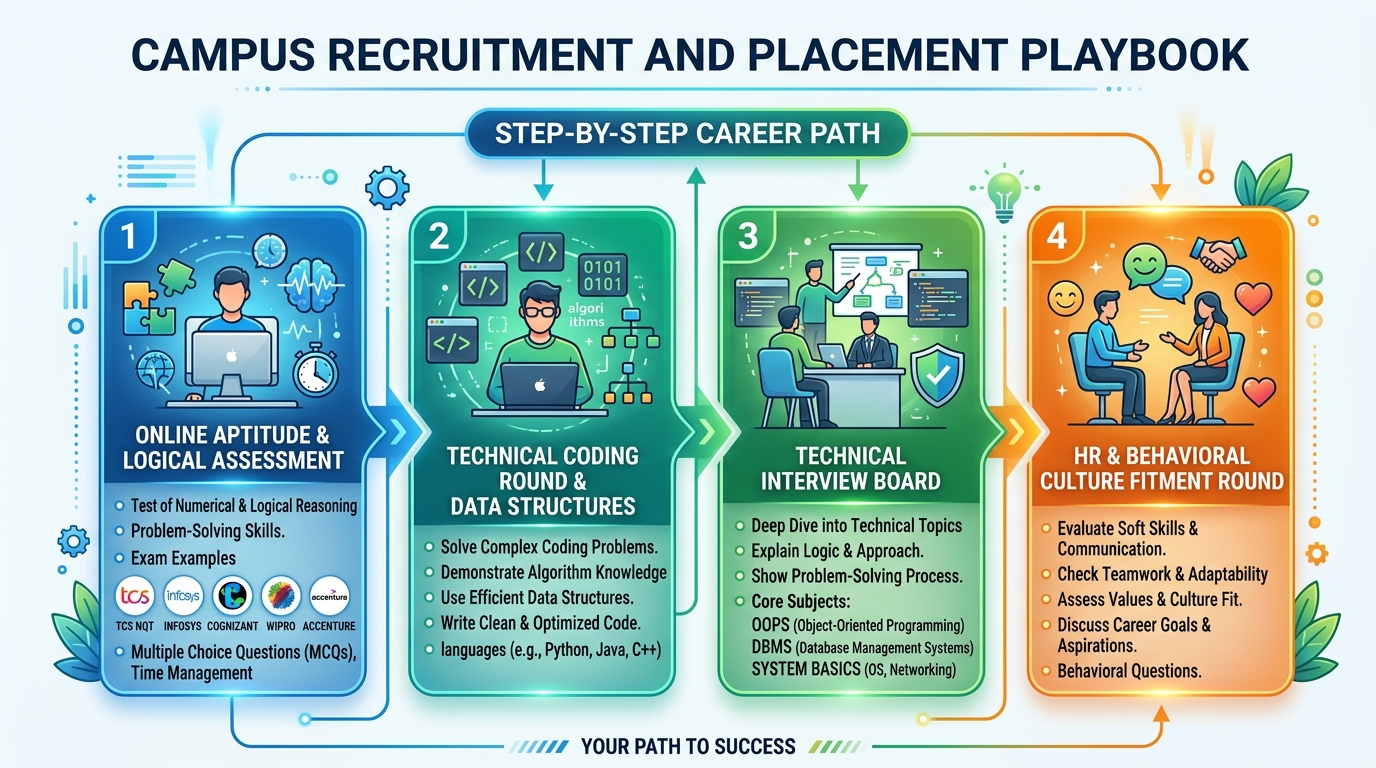
For most campus and off-campus drives, the online aptitude assessment is the first and largest filter. It tests how accurately you can solve familiar question patterns under a strict clock, often with sectional cutoffs. Candidates fail not because the concepts are advanced but because they spend too long on difficult questions, make careless errors or never practiced under timed conditions. A systematic approach to formulas, patterns and time allocation can raise your score quickly.
Core Methodology & Strategic Frameworks
The Three-Pass Time Strategy
A sequencing method for any timed section.
- Pass 1 (about 60% of time): solve every question that you can complete in under a minute
- Pass 2 (about 30% of time): attempt medium questions that need 90 to 120 seconds
- Pass 3 (remaining time): attempt leftover questions or make informed guesses where there is no negative marking
- Never let a single question consume more than 2 minutes in a section with 1-minute average
The High-Yield Topic Map
Prioritize topics that appear most frequently in service and product company tests.
- Quantitative: percentages, profit and loss, ratio and proportion, time and work, speed distance time, simple and compound interest, averages, permutation and combination, probability
- Logical: number and letter series, coding-decoding, blood relations, direction sense, seating arrangements, syllogisms, data sufficiency
- Verbal: reading comprehension, sentence correction, para jumbles, synonyms and antonyms, fill in the blanks
- Data interpretation: tables, bar charts, line graphs and pie charts with percentage change calculations
Quantitative Shortcuts and Formulas
Core techniques to cut calculation time dramatically.
Percentages, Profit & Loss and Ratios
Convert common fractions to percentages: 1/8 = 12.5%, 1/6 = 16.67%, 1/7 = 14.28%, 1/9 = 11.11%. Successive percentage change: net change = a + b + (a x b)/100. If a shopkeeper marks up 20% and gives a 10% discount, selling price = 1.2 x 0.9 = 1.08 times cost, so profit is 8%. For ratio problems, assign a variable per unit and keep the total consistent.
Net % change = a + b + (a × b)/100
Profit % = (SP - CP)/CP × 100
Compound Interest = P(1 + r/100)^n - P
Time & Work and Speed, Distance, Time
In work problems, use the LCM method: take total work as the LCM of individual days, compute efficiency per day, then add efficiencies. If A finishes in 12 days and B in 18 days, assume 36 units; A does 3 units/day, B does 2 units/day, together 5 units/day, so they finish in 7.2 days. For relative speed, add speeds when objects move in opposite directions and subtract when in the same direction. Average speed for equal distances is the harmonic mean: 2xy/(x+y).
- Boats and streams: downstream speed = boat + stream; upstream = boat - stream
- Trains crossing a pole: distance = length of train; crossing a platform: length of train + length of platform
Logical Reasoning and Verbal Ability
Pattern recognition techniques for non-numerical sections.
Seating Arrangements and Syllogisms
For arrangements, draw a diagram immediately, place the definite information first and use conditional statements only after exhausting direct clues. For syllogisms, draw Venn diagrams for each statement and test if the conclusion must always be true in every possible diagram; if it can be false in any, it does not follow.
Reading Comprehension and Sentence Correction
Skim the questions first, read the passage for the main idea and structure, and eliminate options that are extreme, out of scope or contradict the passage. For sentence correction, check subject-verb agreement, tense consistency, parallel structure and pronoun reference before considering style.
Real Interview Questions & Model Responses
Verbatim interview questions asked at top employers with structured thought frameworks and scoring criteria.
A can complete a task in 12 days and B in 18 days. They work together for 4 days, then A leaves. How many more days does B take to finish?
- LCM assumption removes fractions.
- Track units, not fractions of work.
A shopkeeper marks goods 25% above cost price and allows a 20% discount. What is the profit or loss percentage?
- Use 100 as the base for percentage questions.
- Successive changes multiply; they do not add.
Critical Mistakes That Cause Immediate Rejections
- ×Studying formulas passively without timed practice tests.
- ×Spending three or four minutes on a single hard question.
- ×Ignoring sectional cutoffs and weak sections until the last week.
- ×Guessing blindly in tests with negative marking.
- ×Not reviewing mistakes, so the same error types repeat in every mock.
Actionable 30-Day Preparation Checklist
- Take a diagnostic mock test and note your accuracy and speed per topic.
- Practice 30 to 40 questions daily across quant, logical and verbal sections.
- Memorize tables, squares, cubes and fraction-percentage equivalents.
- Maintain an error log with the reason for each mistake: concept, calculation or time.
- Take at least 10 full-length timed mocks in the final three weeks.
- Practice on a laptop with the on-screen calculator style used in the real test if applicable.
- Use the Placement Hub (/placement) company-specific practice sets for TCS, Infosys, Wipro and Accenture patterns.
Frequently Asked Questions
How many days are needed to prepare for aptitude tests?
With a diagnostic and a consistent plan of 1.5 to 2 hours daily, most candidates can make substantial progress in 30 to 45 days. Starting earlier lets you take more mocks.
Is there negative marking in placement aptitude tests?
It varies by company and test. Many mass recruiter tests have no negative marking, while some assessments do. Always read the instructions and adjust your guessing strategy accordingly.
Which section should I prepare first?
Start with the section that has the highest weightage and your lowest score in the diagnostic. For most freshers, quantitative aptitude gives the fastest improvement, followed by logical reasoning.