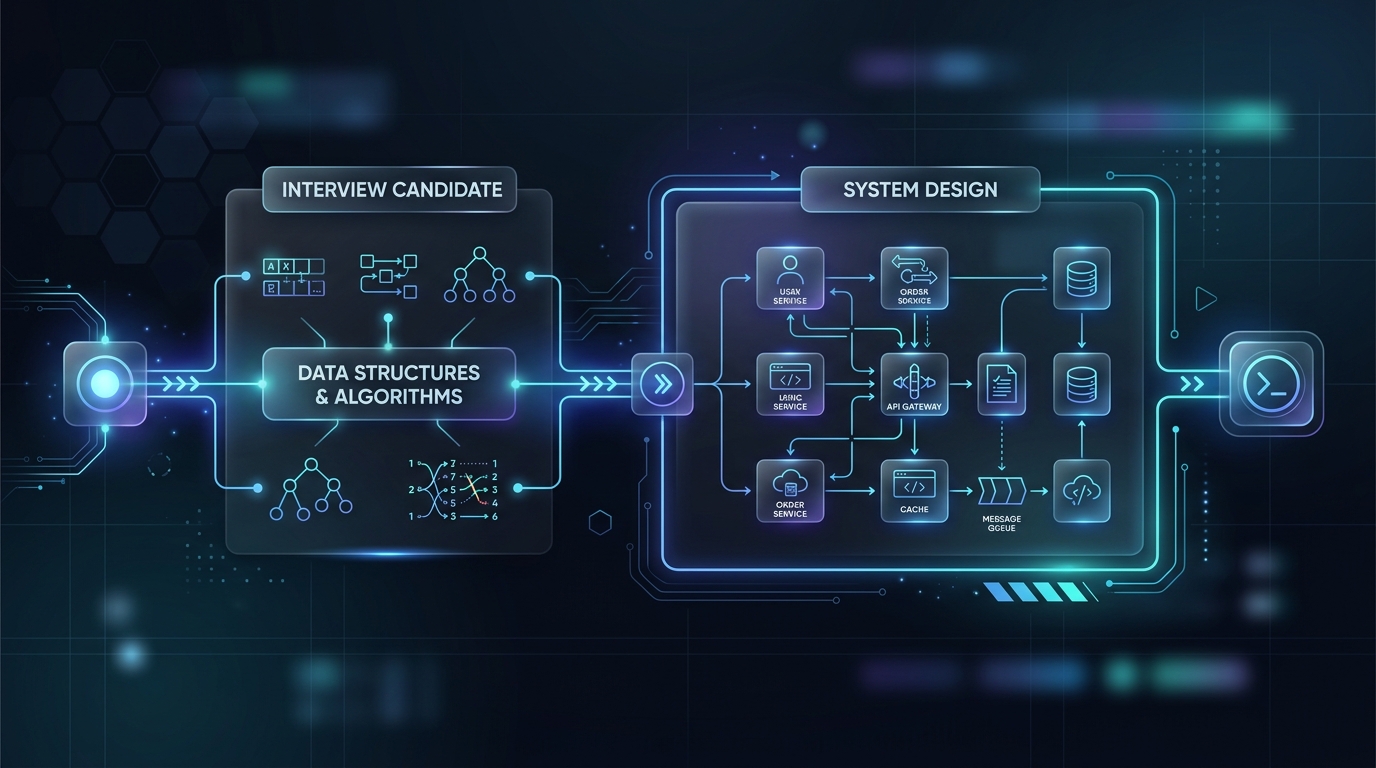
Software Engineer Interview Preparation 2026: Complete Roadmap from Coding to System Design
What You'll Learn in This Masterclass
Software Engineer Interview Evaluation Matrix (SDE-1 vs SDE-2)
| Interview Stage | Primary Competencies Assessed | Typical Duration | Weightage (SDE-1) | Weightage (SDE-2) | Key Passing Benchmark |
|---|---|---|---|---|---|
| Online Assessment (OA) | Algorithmic speed, boundary testing, clean syntax | 60-90 min | 25% (Gatekeeper) | 15% (Gatekeeper) | 100% test cases passed + O(N) or O(N log N) optimal complexity |
| DSA Live Coding (R1 & R2) | Pattern recognition, verbalized thinking, Big-O trade-offs | 45-60 min each | 45% | 30% | Optimal working code within 35 mins + clean modularization |
| CS Fundamentals & LLD | OOP design, SOLID principles, schema modeling, threads | 45-60 min | 20% | 20% | Clean class hierarchy, design pattern application, concurrency awareness |
| High-Level System Design (HLD) | Scalability, microservices, caching, data partitioning, CAP | 45-60 min | Optional / 10% | 25% | Clear bottlenecks identified, realistic back-of-the-envelope math, trade-off defense |
| Behavioral & Bar Raiser | Culture fit, ownership, mentorship, handling failure & ambiguity | 45 min | 10% | 10% | Structured STAR stories demonstrating genuine engineering maturity |
Phased Execution Roadmap
Phase 1: Algorithmic Foundations & Core CS (Days 1–30)
Build instinctive mastery over fundamental data structures, Big-O analysis, and foundational CS concepts.
Phase 2: Complex Patterns, Trees/Graphs & LLD (Days 31–60)
Master non-linear data structures, Dynamic Programming archetypes, and Low-Level Object-Oriented Design.
Phase 3: High-Level System Design, Projects & Mock Interviews (Days 61–90)
Architect distributed systems, defend production projects, and fine-tune live interview communication.
Structured Daily Preparation Schedule
| Time Slot | Activity | Target Focus Area |
|---|---|---|
| 06:30 AM – 08:30 AM (2 hrs) | Algorithmic Problem Solving | Solve 2 targeted pattern problems with zero distractions under timed conditions. |
| 08:30 AM – 09:15 AM (45 min) | Time & Space Complexity Reflection | Document edge cases, alternative approaches, and write post-mortem notes. |
| 06:30 PM – 08:00 PM (1.5 hrs) | System Design or CS Fundamentals | Deep dive into 1 HLD case study or revise OS/DBMS/Networking modules. |
| 08:30 PM – 09:30 PM (1 hr) | Behavioral Prep & Code Review | Refine 1 STAR story, review code written earlier, or practice whiteboarding. |
Visual Architecture & Process Diagrams
The comprehensive 5-to-6 stage interview pipeline used across Tier-1 product firms, unicorns, and FAANG/MAMAA companies in 2026.
A 60-second diagnostic tree for selecting the optimal data structure and problem-solving pattern during a live coding interview.
The 2026 Software Engineer Interview Landscape: What Has Changed?
The tech recruitment ecosystem has experienced a fundamental paradigm shift over the past 24 to 36 months. In earlier hiring cycles, candidates could clear entry and mid-level software engineering interviews by grinding 400 LeetCode questions and regurgitating memorized solutions.
In 2026, automated screening algorithms, generative AI coding assistants, and compressed engineering headcounts have dramatically raised the evaluation bar:
- 1Anti-Memorization & Variant Problems: Interviewers rarely ask verbatim LeetCode questions. Instead, panels present subtle variations with modified constraints (e.g., streaming inputs, extreme memory constraints, or multi-threaded environments) to test whether candidates possess genuine problem-solving intuition or rely on brittle rote memory.
- 2"Think-Aloud" Communication & Pair Programming: The candidate's raw code is now only 40% of the evaluation. Interviewers evaluate how you clarify ambiguous specifications, communicate trade-offs, break problems into modular helpers, and respond when given hints or edge cases.
- 3Deep Systems Grounding: Even for fresh graduates and SDE-1 roles, questions regarding concurrency, database indexing internals, REST vs gRPC trade-offs, and microservice failure recovery are increasingly standard.
- 4Elevated Behavioral & Bar-Raiser Stakes: With tech organizations emphasizing lean engineering teams, senior engineers actively reject candidates who demonstrate toxic individualism, lack of ownership, or inability to communicate architectural decisions constructively.
Mastering the 15 Core Algorithmic Problem-Solving Patterns
Instead of trying to solve all 3,500+ problems on LeetCode, top engineers master the underlying meta-patterns. Virtually every coding interview problem is a composite variation of these 15 patterns:
- Two Pointers (Opposite & Same Direction): Essential for sorted arrays, palindrome validation, and container-with-most-water problems.
- Sliding Window (Fixed & Dynamic Size): Solves substring search, maximum sum subarrays of size K, and longest substring with at most K distinct characters.
- Fast & Slow Pointers (Floyd's Tortoise and Hare): Cycle detection in linked lists, finding middle nodes, and circular array loops.
- Merge Intervals: Meeting room scheduling, calendar conflicts, and interval intersections.
- Monotonic Stack & Queue: Next Greater Element, Daily Temperatures, Largest Rectangle in Histogram, and Sliding Window Maximum.
- Topological Sort (Kahn's Algorithm & DFS): Build systems, course schedules, and package dependency resolution.
- Binary Search on Answer Space: Capacity to ship packages within D days, Koko eating bananas, and split array largest sum.
- Tree Traversals (BFS, DFS, Lowest Common Ancestor): Serializing/deserializing binary trees, zigzag order, and path sum problems.
- Dynamic Programming (0/1 Knapsack, Unbounded Knapsack, LCS, LIS): State transitions with optimal substructure and overlapping subproblems.
- Backtracking (Combinations, Permutations, Sudoku Solver): Systematic state-space tree pruning with constraint validation.
Worked Implementation: Variable-Size Sliding Window Pattern
Let us examine how an optimal sliding window pattern is articulated during a live interview.
Problem Statement: Given an array of positive integers nums and a positive integer target, return the minimal length of a contiguous subarray of which the sum is greater than or equal to target. If there is no such subarray, return 0.
function minSubArrayLen(target: number, nums: number[]): number {
  let minLength = Infinity;
  let windowSum = 0;
  let left = 0;

  // Expand the right boundary of the window
  for (let right = 0; right < nums.length; right++) {
    windowSum += nums[right];

    // Shrink window from the left while the constraint is satisfied
    while (windowSum >= target) {
      const currentLength = right - left + 1;
      minLength = Math.min(minLength, currentLength);

      // Remove left element and advance left pointer
      windowSum -= nums[left];
      left++;
    }
  }

  return minLength === Infinity ? 0 : minLength;
}

// Time Complexity: O(N) — each element is added and removed at most once.
// Space Complexity: O(1) — constant auxiliary space used.Computer Science Fundamentals: The 4 Non-Negotiable Pillars
A common reason strong competitive programmers fail product company interviews is weakness in foundational computer science principles. Panelists frequently pivot from a coding problem directly into operating system or database internals.
1. Operating Systems & Concurrency
- Processes vs. Threads: Separate virtual address spaces vs shared memory within a single process. Context switching overhead (saving CPU registers, program counter, and flushing TLB caches).
- Concurrency Primitives: Race conditions, critical sections, Mutex vs Counting Semaphore, Read-Write locks, and deadlock handling (the 4 Coffman conditions: Mutual Exclusion, Hold & Wait, No Preemption, Circular Wait).
- Virtual Memory & Paging: Page tables, TLB (Translation Lookaside Buffer) hit/miss mechanics, Page Fault handling, and LRU cache eviction logic.
2. Database Management Systems (DBMS)
- ACID Guarantees: Atomicity (Write-Ahead Logging / WAL), Consistency (foreign keys, domain constraints), Isolation (Read Uncommitted, Read Committed, Repeatable Read, Serializable), and Durability.
- Indexing Mechanics: B+ Tree vs Hash Index. Why B+ Trees are ideal for disk I/O (high fan-out, shallow height, leaf node sequential linked pointers for range queries).
- Database Normalization vs Denormalization: 1NF, 2NF, 3NF, and BCNF. When and why production architectures denormalize read-heavy tables to prevent expensive distributed joins.
3. Computer Networks
- HTTP/1.1 vs HTTP/2 vs HTTP/3: Head-of-Line (HoL) blocking at the application layer vs transport layer. Binary framing, multiplexing over a single TCP stream in HTTP/2, and UDP-based QUIC in HTTP/3.
- TCP vs UDP: Three-way handshake (SYN, SYN-ACK, ACK), flow control (sliding window), congestion control (Slow Start, Congestion Avoidance, Fast Retransmit), and four-way termination handshake (FIN/ACK).
- HTTPS & TLS Handshake: Asymmetric key exchange (RSA or ECDHE) to negotiate ephemeral symmetric session keys (AES-GCM) with X.509 certificate validation.
4. Object-Oriented Programming (OOP) & SOLID Principles
- Single Responsibility Principle (SRP): A class should have only one reason to change.
- Open/Closed Principle (OCP): Software entities should be open for extension, but closed for modification.
- Liskov Substitution Principle (LSP): Subtypes must be substitutable for their base types without altering program correctness.
- Interface Segregation Principle (ISP): Clients should not be forced to depend on interfaces they do not use.
- Dependency Inversion Principle (DIP): High-level modules should depend on abstractions, not concrete implementations.
System Design Interview Mastery: Low-Level vs. High-Level Design
System design interviews evaluate your ability to architect robust, scalable, and maintainable software systems under ambiguous real-world constraints.
Low-Level Design (LLD) & Object-Oriented Modeling
Primarily emphasized for SDE-1 and early SDE-2 roles. The interviewer presents a vague system (e.g., "Design an In-Memory Cache with TTL", "Design an Elevator Management System", or "Design a Chess Game") and assesses:
- Class diagrams and entity relationship modeling.
- Clean separation of concerns (Controller, Service, Repository layers).
- Proper application of Gang of Four (GoF) design patterns:
- Creational: Factory Method, Builder, Singleton (thread-safe double-checked locking).
- Structural: Adapter, Decorator, Facade.
- Behavioral: Strategy (swapping algorithms at runtime), Observer (event bus), State pattern.
- Concurrency handling and thread safety.
High-Level Design (HLD) Framework
Mandatory for SDE-2 and senior engineering candidates. Follow this disciplined 6-step framework during the 45-minute round:
- 1Scope Clarification & Requirements Gathering (5 mins): Functional requirements (what the system must do) vs Non-Functional requirements (scalability, 99.99% availability, latency < 50ms, data durability).
- 2Back-of-the-Envelope Estimation (5 mins): Daily Active Users (DAU), Read:Write ratio, QPS (Queries Per Second), bandwidth, and 5-year storage capacity.
- 3API Design (5 mins): Clean REST or RPC endpoints with payload schemas and authentication tokens.
- 4Data Model & Schema Selection (5 mins): SQL (relational, strict ACID, financial transactions) vs NoSQL (Key-Value, Document, Wide-Column, Graph) with indexing strategy.
- 5High-Level Architectural Diagram (15 mins): Client -> CDN/DNS -> Reverse Proxy / API Gateway -> Stateless Application Services -> Distributed Cache (Redis) -> Primary/Replica Databases + Async Message Queue (Kafka) -> Background Workers.
- 6Bottlenecks, Deep Dives & Trade-offs (10 mins): Cache invalidation (Cache-Aside vs Write-Through), single points of failure (SPOF), rate limiting, database sharding keys, and CAP theorem trade-offs (CP vs AP under network partitions).
How to Defend Your Projects Using the STAR-P Framework
When an interviewer asks: "Walk me through the most technically challenging project you have worked on," over 70% of candidates fail by summarizing generic CRUD features ("I built a portal using React and Node.js").
Top candidates use the STAR-P Framework:
- Situation: Context, team size, users impacted, and the fundamental business problem.
- Task: The specific engineering bottleneck you were personally assigned to solve.
- Action: The concrete architectural decisions, algorithms, and design choices you made.
- Result: Quantifiable business and technical metrics (e.g., "Reduced P99 latency from 450ms to 85ms", "Cut AWS infrastructure costs by 32%").
- Post-Mortem / Trade-offs (The 'P'): What broke, what you learned, and what you would architect differently today with hindsight.
Sample Script for Answering Project Questions:
*"In my previous project, our core checkout microservice suffered from cascading connection timeouts during peak flash sales. As the lead backend engineer on the task, I identified through distributed tracing that synchronous database queries were exhausting our connection pool. I redesigned the checkout pipeline by decoupling order ingestion from inventory allocation using an Apache Kafka event stream with idempotent consumer workers.
This dropped our checkout P99 response time from 1.2 seconds down to 140ms and handled a 4x traffic surge with zero dropped orders. In hindsight, the trade-off was introducing eventual consistency into the order status, which required us to build an asynchronous webhook notification service for the frontend client."*
Cracking Behavioral & Bar-Raiser Rounds
The Bar-Raiser round (popularized by Amazon and adopted widely across tech companies) exists to ensure that every new hire raises the average talent bar of the organization.
Behavioral interviews test for 4 primary dimensions:
- 1Ownership & Accountability: Taking responsibility when systems fail rather than blaming teammates or third-party dependencies.
- 2Handling Technical Disagreements: Disagreeing respectfully with data, prototypes, and benchmarking, followed by the maturity to "commit" once a team decision is finalized.
- 3Navigating Ambiguity: Delivering incremental progress when specifications, requirements, or business goals are ill-defined.
- 4Customer Obsession & Impact: Prioritizing genuine user experience and operational reliability over shiny new technologies.
High-Frequency Interview Questions & Frameworks
Given an array of integers nums and an integer target, return indices of the two numbers such that they add up to target. Can you do it in less than O(N^2) time complexity?
How would you design a distributed, high-throughput URL shortener service (like TinyURL) capable of handling 100 million new URLs per month with sub-20ms read latencies?
Tell me about a time you had a fundamental technical disagreement with a teammate or senior engineer. How did you resolve it?
Costly Mistakes to Avoid
- ✕Memorizing LeetCode solutions instead of mastering pattern templates (Sliding Window, Two Pointers, Top-K).
- ✕Jumping straight into code before validating constraints and explaining the brute-force time/space complexity.
- ✕Ignoring edge cases (empty arrays, integer overflow, null pointers, single-element inputs).
- ✕Neglecting Low-Level Design (LLD) and writing monolithic, tightly coupled code without SOLID principles.
- ✕Designing systems without doing back-of-the-envelope calculations to justify architectural decisions.
- ✕Treating behavioral and bar-raiser rounds as an afterthought and speaking in vague generalities.
Key Takeaways
- •Pattern recognition beats problem memorization every single time.
- •Live interviews are collaborative problem-solving simulations: communicate your thought process constantly.
- •System design is about defending trade-offs, not drawing complex diagrams that you cannot explain.
- •Strong behavioral answers separate candidates who get SDE-1 offers from candidates who get leveled at SDE-2 or Senior.
- •Consistency over 90 days with targeted mock practice is the proven formula for technical interview success.
Final Interview Checklist
- Master the 15 core algorithmic patterns and be able to implement them in your primary language without IDE help.
- Practice solving at least 150 curated medium-level problems under a strict 25-minute timer.
- Review Operating Systems: Thread synchronization, deadlocks, and virtual memory.
- Review DBMS: B+ Tree indexes, transaction isolation levels, and ACID guarantees.
- Review Networking: TCP 3-way handshake, TLS exchange, HTTP/2 multiplexing.
- Prepare 4 complete Low-Level Designs (Parking Lot, Cache, Rate Limiter, Splitwise) with clean class diagrams.
- Prepare 6 complete High-Level Designs (URL Shortener, Video Platform, Chat App, Feed System, Rate Limiter, Metrics Monitor).
- Draft 6 STAR behavioral stories covering leadership, technical conflicts, failures, and ambiguity.
- Complete at least 5 full-length mock interviews with senior engineers or peers before your first live interview.
Frequently Asked Questions (FAQs)
How many LeetCode questions do I actually need to solve to get an SDE job in 2026?
You do NOT need to solve 1,000+ problems. A disciplined focus on 150 to 200 carefully selected problems across the 15 core patterns (approx. 30 Easy, 130 Medium, 20 Hard) provides more than enough coverage. Quality of understanding, variation testing, and verbalizing your thought process matter far more than sheer question count.
Is System Design required for freshers (SDE-1) or campus placement interviews?
While High-Level Distributed System Design (HLD) is rarely expected from freshers, Low-Level Design (LLD), Object-Oriented Modeling, and Database Schema Design are frequently tested. Top product firms will expect freshers to design clean class hierarchies (e.g., Parking Lot, Tic-Tac-Toe) adhering to SOLID principles.
What programming language is best for coding interviews?
Use the language you are most fluent in. Python, Java, and C++ are the most widely accepted. Python has the advantage of concise syntax and rich built-in collections (heapq, deque, bisect), while Java and C++ demonstrate explicit type safety and memory management understanding. Avoid switching to a new language right before interview season.
How do I handle getting stuck on a coding problem during a live interview?
Never sit in silence. State your current thinking to the interviewer: "I can solve this in O(N^2) using brute force by checking all pairs, but I am looking for a way to optimize this to O(N log N) or O(N). Let me see if storing past elements in a hash map or sorting the input first helps." Interviewers want to see how you troubleshoot and will often provide subtle hints if you communicate transparently.
How long does it take to prepare for software engineering interviews from scratch?
For candidates with a computer science background or prior programming experience, 3 months (90 days) of structured, daily 3-to-4 hour preparation is standard. If you are a complete beginner or career switcher, plan for 6 to 9 months to build core data structure fundamentals before tackling advanced system design.
What is the difference between SDE-1 and SDE-2 interview expectations?
SDE-1 interviews focus primarily on raw algorithmic problem solving, clean code syntax, and basic CS fundamentals. SDE-2 interviews place heavy weight on High-Level System Design (scalability, microservice partitioning, distributed data stores), Low-Level Design patterns, production debugging, and behavioral leadership.
How should I explain career gaps or job transitions during tech interviews?
Be direct, transparent, and concise. State the context (e.g., family care, upskilling, travel, or company restructuring) in one or two sentences, and immediately pivot to the technical skills and projects you mastered during that time. Focus 90% of the answer on your current readiness and passion for software engineering.
What are the best platforms to conduct realistic mock technical interviews?
Pramp and Interviewing.io offer anonymous peer and FAANG-engineer mock interviews. You can also pair with college peers or colleagues to run timed 45-minute sessions using Google Docs or shared coderpads without syntax highlighting.
Authoritative References & Standards
The definitive architectural guide on storage engines, distributed consensus, transactions, and replication trade-offs.
Authoritative standards on software architecture, design patterns, and engineering testing benchmarks.
Official IETF standard governing HTTP methods, status codes, and caching semantics.