System Design Interview Guide: Complete Preparation Roadmap with Real Examples
What You'll Learn in This Masterclass
Distributed System Building Blocks & Trade-off Matrix
| Architecture Component | Primary Function | Key Technologies | Trade-off / Bottleneck | Interview Pro-Tip |
|---|---|---|---|---|
| Load Balancer (L4 vs L7) | Traffic distribution & health checks | Nginx, HAProxy, AWS ALB/NLB | L7 inspects HTTP payload but incurs CPU overhead; L4 is faster at packet level | Discuss sticky sessions vs stateless token routing. |
| Distributed Cache | Sub-millisecond read acceleration | Redis, Memcached | Cache invalidation complexity & stale data risk | Always explain cache stampede and Thundering Herd mitigation. |
| Message Queue / Bus | Asynchronous task decoupling | Apache Kafka, RabbitMQ, AWS SQS | Introduces eventual consistency and consumer lag | Kafka guarantees partition-level ordering, not global ordering. |
| Relational DB (RDBMS) | Strict ACID transactional integrity | PostgreSQL, MySQL | Horizontal write scaling requires complex sharding | Ideal for financial transactions and strict foreign key integrity. |
| Distributed NoSQL | Planetary scale horizontal writes | Cassandra, DynamoDB, MongoDB | Sacrifices immediate consistency (BASE model) | Cassandra uses masterless peer-to-peer ring topology with tuneable consistency. |
Phased Execution Roadmap
Phase 1: Distributed Primitives & Networking (Days 1–15)
Master latency numbers, networking protocols, load balancing, and consistent hashing.
Phase 2: Storage, Caching & Data Consistency (Days 16–30)
Deep dive into database replication, sharding strategies, caching topologies, and transactions.
Phase 3: End-to-End System Architectures (Days 31–45)
Architect 6 complete production-scale systems using the 6-step HLD framework under timed simulation.
Visual Architecture & Process Diagrams
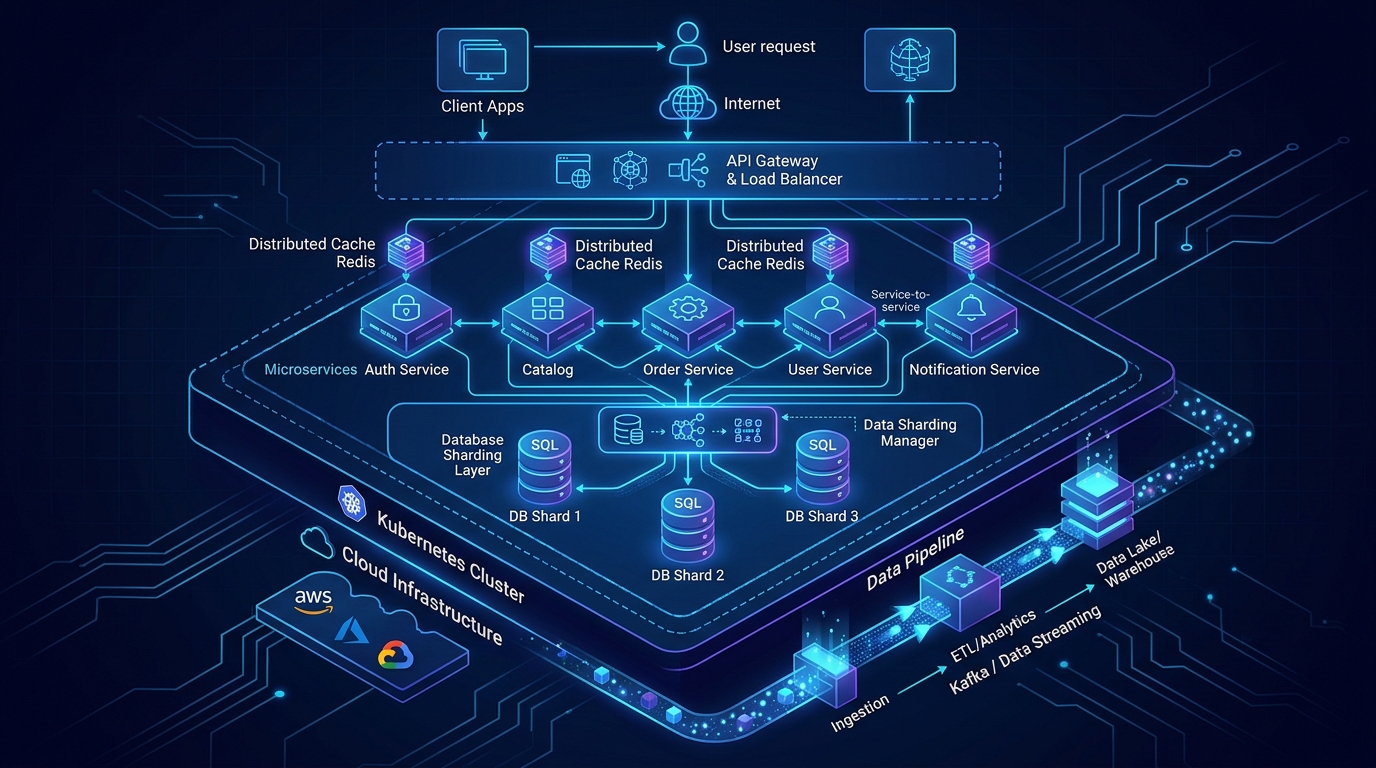
A complete multi-tier high-level system architecture showing edge CDNs, API gateways, stateless microservices, distributed cache, sharded databases, and event streaming workers.
The 6-Step System Design Interview Framework
The greatest error candidates commit in system design interviews is jumping directly to drawing boxes on the whiteboard without scoping the problem. Top engineers execute a structured, collaborative 45-minute blueprint:
Step 1: Requirements Clarification (3–5 Mins)
- Functional Requirements: The 2 or 3 core operations the user can perform (e.g., "Post a tweet", "View timeline", "Follow a user").
- Non-Functional Requirements:
- High Availability (e.g., 99.99% uptime) vs Strict Consistency.
- Low Latency (Read P99 < 50ms, Write P99 < 150ms).
- Scale (e.g., 500 million Daily Active Users).
Step 2: Back-of-the-Envelope Estimation (3–5 Mins)
- Throughput (QPS):
500M DAU * 10 reads/day = 5B requests / 86,400s ≈ 60,000 QPS. Peak QPS = 2x average = 120,000 QPS. - Storage & Bandwidth: Calculating 5-year disk capacity and outbound egress megabytes per second.
Step 3: API & Protocol Definition (3–5 Mins)
- Define clean REST or RPC endpoints:
POST /v1/posts->{ text, media_urls }-> returns{ post_id, created_at }GET /v1/feed?user_id=123&cursor=xyz-> returns array of posts with pagination.
Step 4: High-Level Architectural Flow (10–15 Mins)
- Draw the foundational end-to-end data flow: Client -> Load Balancer -> Stateless Web Tier -> Cache -> Database.
Step 5: Data Model & Schema Design (5–8 Mins)
- Choosing between relational (PostgreSQL) vs NoSQL (Cassandra, DynamoDB, MongoDB) based on query patterns, access frequency, and data relationality.
Step 6: Deep Dives & Bottleneck Resolution (10–12 Mins)
- Single points of failure (SPOF), horizontal database sharding keys, cache invalidation protocols, and distributed rate limiting.
CAP vs. PACELC: The Theoretical Foundation of Distributed Trade-offs
In any asynchronous network, network partitions (communication breakdown between servers) are inevitable. According to Eric Brewer's CAP Theorem, a distributed data store can simultaneously provide at most two out of three guarantees:
- Consistency (C): Every read receives the most recent write or an error (Linearizability).
- Availability (A): Every non-failing node returns a non-error response, without guaranteeing it contains the most recent write.
- Partition Tolerance (P): The system continues to operate despite an arbitrary number of messages being dropped or delayed by the network.
Because real networks cannot eliminate partitions (P is non-negotiable), distributed systems must choose between CP (Consistency over Availability, e.g., HBase, Spanner, ZooKeeper) and AP (Availability over Consistency, e.g., Cassandra, DynamoDB, CouchDB).
The PACELC Extension:
Daniel Abadi extended CAP to address normal operations: If there is a Partition (P), trade off Availability (A) vs Consistency (C); Else (E), trade off Latency (L) vs Consistency (C). For instance, MongoDB is PC/EC (prefers consistency under partition and lower latency over strong consistency in normal state), while Cassandra is PA/EL.
Caching Topologies & Horizontal Database Sharding
1. Caching Invalidation Strategies
- Cache-Aside (Lazy Loading): The application first queries the cache. On cache miss, it reads from the database, writes the entry to the cache, and returns it. Low overhead, but initial requests experience higher latency.
- Write-Through: Application writes to the cache, and the cache synchronously writes to the database before acknowledging. Guarantees cache-DB sync, but incurs higher write latency.
- Write-Behind (Write-Back): Application writes to the cache, which acknowledges immediately and asynchronously flushes batches to the database. Lightning fast writes, but risks data loss if the cache node crashes before flushing.
2. Database Sharding Mechanics
When a single database server exceeds RAM, disk I/O, or connection limits, we horizontally partition data across multiple database nodes (shards):
- Consistent Hashing: Arranges hash values along an abstract 360-degree ring (0 to 2^32 - 1). Nodes are assigned positions on the ring. Each key is mapped to the nearest clockwise node. Adding or removing a node only impacts
K / Nkeys (where K is total keys and N is total nodes), preventing mass data reshuffling.
High-Frequency Interview Questions & Frameworks
Design a scalable Distributed Rate Limiter to protect our public API from DDoS and abusive scraping. It must handle 100,000 requests per second with sub-2ms overhead.
rate_limit:{user_id}:{minute_timestamp} stored in a clustered Redis deployment with TTLs of 2 minutes. When a request arrives, the gateway executes an atomic Redis Lua script that calculates the weighted request count from the current and previous minute windows. If the combined count exceeds the quota (e.g., 100 req/min), it returns HTTP 429 with Retry-After header. By running the logic in an atomic Lua script, we eliminate race conditions across distributed gateway instances with under 1.5ms network latency over local VPC peering.How would you design a Ride-Matching dispatch system (like Uber or Lyft) to match nearby available drivers with riders in real time?
WHERE distance(lat, lon) < 2km under high scale. Propose Geohash (encoding lat/long into base32 alphanumeric strings) or Google S2 (hierarchical Hilbert space-filling curve). 3. Architecture: Driver apps send GPS pings every 4 seconds over WebSockets to a Location Ingestion Service. Location updates are stored in a distributed in-memory spatial index (Redis GEO commands based on Geohash). 4. Ride Dispatch: When a rider requests a ride, the Dispatcher queries the spatial index for drivers within Geohash precision level 6 (~1.2km), locks the best driver candidate atomically, and dispatches the offer.Costly Mistakes to Avoid
- ✕Diving straight into whiteboard architecture without agreeing on functional and non-functional requirements.
- ✕Throwing trendy technologies (e.g., "We will use Kafka, GraphQL, and Cassandra") without justifying why.
- ✕Failing to calculate back-of-the-envelope estimations to prove scale requirements.
- ✕Ignoring data consistency trade-offs and assuming distributed databases provide magic zero-latency ACID guarantees.
- ✕Not addressing single points of failure (SPOF) or network partition scenarios.
Key Takeaways
- •There are no perfect system designs—only trade-offs between latency, consistency, cost, and complexity.
- •Back-of-the-envelope math validates whether your architecture can physically run on modern hardware.
- •Stateless application servers make horizontal auto-scaling trivial; stateful database layers require sharding.
- •Eventual consistency is the price of planetary availability under network partitions.
Final Interview Checklist
- Master the 6-step HLD interview framework and adhere to time limits (45 minutes).
- Be fluent in back-of-the-envelope calculations: QPS, storage, memory, and bandwidth.
- Understand Layer 4 vs Layer 7 load balancers, reverse proxies, and SSL termination.
- Be able to explain Consistent Hashing with virtual nodes and rebalancing on a whiteboard.
- Compare SQL vs NoSQL (Cassandra, DynamoDB, MongoDB, Redis) based on concrete access patterns.
- Know cache invalidation strategies (Cache-Aside, Write-Through, Write-Behind) and eviction algorithms.
- Understand distributed locking (Redlock), idempotency keys, and Saga transaction patterns.
Frequently Asked Questions (FAQs)
What is the difference between Low-Level Design (LLD) and High-Level Design (HLD)?
LLD focuses on object-oriented class diagrams, design patterns (Factory, Strategy, Observer), clean code, and database schema normalization within a single application process. HLD focuses on distributed system architecture: services, microservices, load balancers, caching layers, message queues, and cross-server communication across clusters.
How do you prevent the Thundering Herd (Cache Stampede) problem?
Cache stampede occurs when a high-traffic cache key expires, causing thousands of concurrent requests to hit the database simultaneously. Mitigate this by: 1. Using a distributed mutex lock so only the first request queries the database while others wait. 2. Implementing probabilistic early expiration (XFetch algorithm). 3. Pre-warming and refreshing the cache in the background via cron workers.
When should I choose SQL over NoSQL in a system design interview?
Choose SQL when your application requires complex joins, ACID compliance (like banking, ledgers, or payment transactions), and has well-defined relational schemas. Choose NoSQL when you have massive write throughput (hundreds of thousands of writes/sec), schema flexibility, and query patterns that read data by a single primary partition key without joins.
What is Consistent Hashing and why is it superior to simple modulo hashing?
Simple modulo hashing hash(key) % N maps keys across N servers, but if one server fails or is added, almost all keys map to different servers, causing an instantaneous cache miss storm. Consistent Hashing maps both keys and servers to an abstract ring (0 to 2^32-1); adding or removing a node only redistributes K / N keys to immediate neighbors.
How do you ensure idempotency in distributed APIs?
Clients generate a unique Idempotency Key (UUID v4) and attach it as an HTTP header (e.g., Idempotency-Key: abc-123). The API Gateway or service checks a distributed store (like Redis) for this key. If found, it returns the previously cached response without re-executing the operation. If not found, it acquires an atomic lock, processes the write, caches the result, and releases the lock.
What is the Saga pattern in microservices?
The Saga pattern manages distributed transactions across multiple independent microservices without locking resources across distributed networks. It breaks a business transaction into a sequence of local transactions. If one local transaction fails, the Saga executes compensating transactions in reverse order to undo the preceding changes.
What are the trade-offs of Microservices vs Monoliths?
Microservices allow independent deployment, technology diversity, and localized scaling, but introduce distributed network latency, operational overhead (Kubernetes, distributed tracing), and complex eventual consistency. Monoliths are simpler to develop, test, and deploy with zero cross-network function call overhead, but scale as a single unit.
How should I practice system design if I have not built large-scale systems at work?
Read real-world engineering blogs (Netflix Tech Blog, Uber Engineering, Meta Engineering, Discord Blog), study Martin Kleppmann’s "Designing Data-Intensive Applications", and practice whiteboarding end-to-end architectures out loud within a 45-minute timer.
Authoritative References & Standards
The industry-standard reference text on storage engines, distributed consensus, replication, and partitioning.
Official cloud architecture standards for building fault-tolerant, horizontally scalable distributed applications.