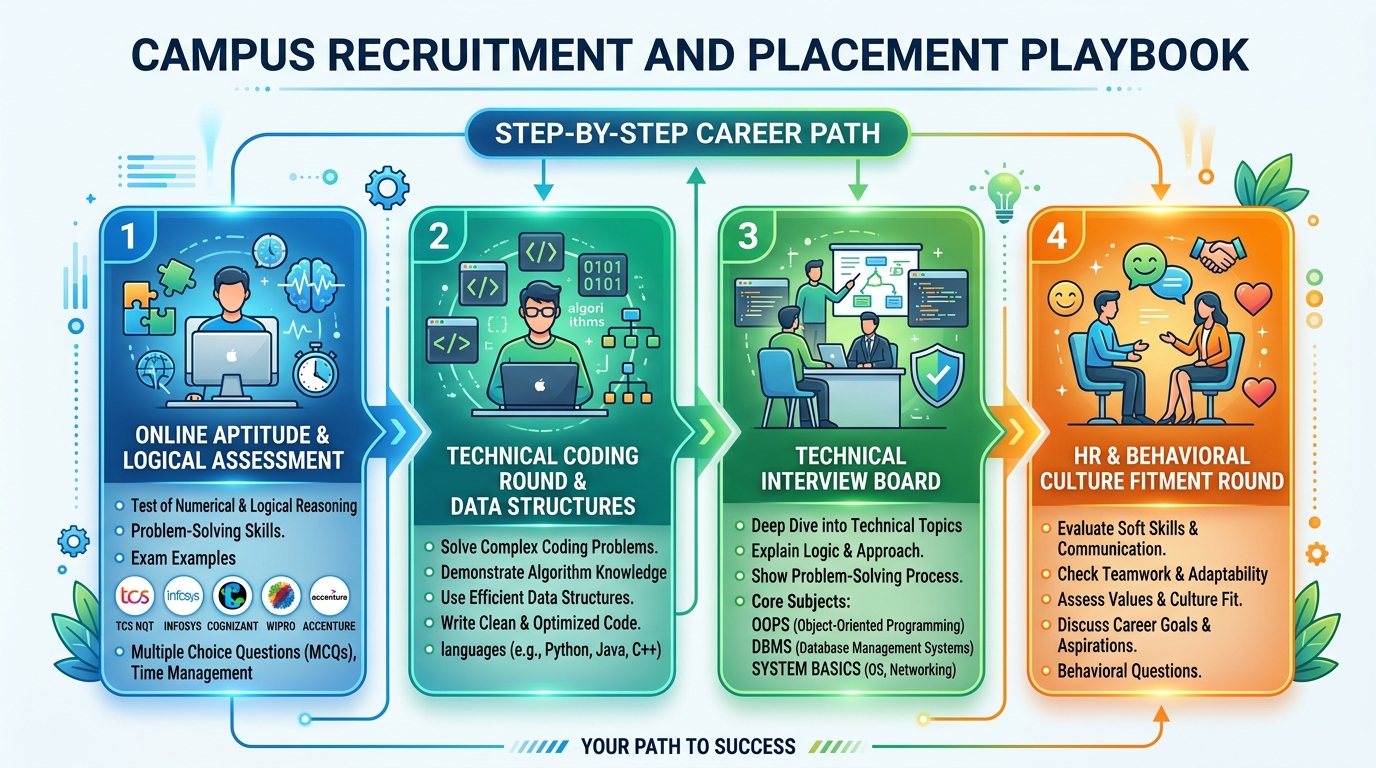
Campus Placement Preparation: Complete Roadmap for Engineering & College Freshers
What You'll Learn in This Masterclass
Quick Reference Matrix
| Company Category | Typical Employers | Primary Screening Mechanism | Key Preparation Focus & Cutoffs |
|---|---|---|---|
| Mass Recruiters / IT Services | TCS (Ninja/Digital), Infosys, Cognizant, Wipro, Accenture, Capgemini | National Qualifying Aptitude Tests (NQT) + Basic Coding (Array/String) | Speed Aptitude (Quant, Verbal, Reasoning), basic C++/Java/Python syntax, clear communication |
| Mid-Tier Tech & FinTech | Cisco, Samsung, Oracle, Dell, Standard Chartered, Societe Generale | Medium DSA (Trees, Graphs, DP) + Core CS Fundamentals MCQ | LeetCode Medium, DBMS normalization, SQL joins, OS concurrency & multithreading |
| Tier-1 Product & Big Tech | Amazon, Microsoft, Google, Adobe, Uber, Atlassian, Flipkart | Hard algorithmic coding (2 Qs in 90 mins) + System Design LLD basics | Advanced DSA (Graphs, Dynamic Programming, Tries), Low-Level Design (SOLID), clean code modularity |
| High-Growth Startups | Razorpay, Zepto, Swiggy, Cred, BrowserStack | Machine Coding Round (Build a functional mini-app in 2 hours) + In-depth project grilling | Hands-on development (React/Node/Go), GitHub contributions, live debugging, API architecture |
Phased Execution Roadmap
Semester 5 (Month 1-3): Foundational Coding & Core CS Subjects
Master one primary programming language and establish foundational CS theory.
Semester 6 (Month 4-6): Intermediate DSA & Aptitude Drilling
Scale problem-solving to trees, graphs, and begin quantitative aptitude practice.
Semester 7 Summer (Month 7-9): Resume Polish & Assessment Mocks
Optimize ATS resume, practice company-specific assessment papers, and build mock projects.
Semester 7-8 Placements (Month 10-12): Live Drives & Interview Mastery
Execute on-campus drives, maintain psychological stamina, and convert offers.
Visual Architecture & Process Diagrams
End-to-end filtration process from 1,000+ campus applicants down to the final offer letter.
Product-Based vs Service-Based Preparation Strategies
The most common mistake college students make is adopting a one-size-fits-all preparation strategy. Product-based companies (Google, Amazon, Adobe, Razorpay) and mass IT service recruiters (TCS, Infosys, Wipro, Cognizant) evaluate completely different skillsets.
1. The Mass Recruiter / Service Company Track
- Hiring Model: High volume (hundreds of hires per campus).
- Core Gatekeeper: The Online Aptitude Test. If you score below the 75th percentile in Speed Math, Logical Puzzles, and Verbal Ability, you are disqualified regardless of your coding skills.
- Coding Expectation: Basic programming syntax: Strings, Arrays, Searching, Sorting, and Palindrome/Fibonacci patterns.
- Interview Style: Friendly, verifying conversational English, willingness to relocate, flexibility with technology stacks, and foundational OOP definitions.
2. The Tier-1 Product Company Track
- Hiring Model: Low volume, high compensation (select few hires per campus).
- Core Gatekeeper: High-difficulty Algorithmic Coding Tests (HackerEarth, HackerRank).
- Coding Expectation: Deep Data Structures & Algorithms: Graphs (Dijkstra, Topological sort), Dynamic Programming (Knapsack, LCS), Trees, and Tries.
- Interview Style: Rigorous problem-solving. Interviewers do not care about definitions; they present unseen algorithmic puzzles and expect candidates to analyze Time Complexity ($O(N \log N)$ vs $O(N^2)$) and write clean, modular, production-ready code.
Acing the Online Assessment (OA): Compiler & Time Hacks
The Online Assessment (OA) is an automated slaughterhouse where 70-80% of students are rejected without human review.
1. Surviving the Coding Section:
- Pass All Sample Test Cases First: Never spend 30 minutes optimizing for $O(N)$ if a brute force $O(N^2)$ solution can be written in 5 minutes. Submit the brute-force solution to lock in partial marks (typically 40-60% of test cases pass) before attempting optimization.
- Watch Out for Integer Overflow: In C++ and Java, multiplying two $10^5$ integers results in $10^{10}$, which overflows standard 32-bit signed integers (
int), producing negative numbers. Always uselong longin C++ orlongin Java for cumulative sums and products. - Edge Cases Checklist: Always test your code mentally against:
- 1Empty input / null pointer.
- 2Single element array.
- 3Array with all identical elements.
- 4Negative numbers and zero.
- 5Maximum constraint size (e.g., $N = 10^5$).
2. Speed Aptitude Tactics:
- Never spend more than 60 seconds on an aptitude question. If a problem statement is 6 lines long, skip it and solve the 1-line percentage and ratio questions first.
- In multiple-choice questions, use option elimination and unit-digit arithmetic rather than full multi-digit multiplication.
ios_base::sync_with_stdio(false); cin.tie(NULL);. This prevents standard I/O bottlenecks from causing Time Limit Exceeded (TLE) errors.Core Computer Science Fundamentals: The Technical Interview Defense
Once past the coding round, technical interviewers will grill you on the four pillars of Computer Science:
1. Database Management Systems (DBMS):
- ACID Properties: Atomicity (all-or-nothing), Consistency (data integrity constraints), Isolation (concurrent transactions don't interfere), Durability (committed changes persist through crashes).
- Indexing Mechanics: How B+ Trees enable $O(\log N)$ lookups; Clustered (orders physical rows, only 1 per table) vs Non-Clustered indexes.
- Normalization: 1NF (atomic values), 2NF (remove partial dependencies), 3NF (remove transitive dependencies). Be ready to normalize an unnormalized student-course table on paper.
- SQL Joins: INNER, LEFT, RIGHT, FULL OUTER, and CROSS joins. Expect to write live SQL queries using
GROUP BY,HAVING, and aggregate functions.
2. Operating Systems (OS):
- Process vs Thread: A process has its own dedicated memory space; threads share the memory space of their parent process.
- Deadlock Conditions (Coffman Conditions): Mutual Exclusion, Hold and Wait, No Preemption, Circular Wait. Explain how to break Circular Wait using resource ordering.
- Virtual Memory & Paging: Translating virtual addresses to physical addresses via the Page Table and Translation Lookaside Buffer (TLB); Page Fault mechanics.
3. Object-Oriented Programming (OOP):
- The 4 Pillars: Encapsulation (data hiding), Abstraction (hiding implementation details), Inheritance (code reuse), Polymorphism (Compile-time overloading vs Runtime overriding).
- Explain abstract classes vs interfaces with a practical code example.
Fresher HR Interview: Confidence, Loyalty & Red Flags
The HR round for freshers is primarily a test of stability, communication, coachability, and corporate alignment.
1. Handling the Classic Fresher Questions:
- "Why should we hire you when you have zero industry experience?"
- Winning Answer: Focus on high learning velocity, foundational rigor, lack of bad professional habits, and enthusiasm to be molded into the company’s specific engineering culture.
- "Are you willing to relocate anywhere in India and work in rotational night shifts?"
- The Golden Rule: Always answer "Yes, absolutely." Hesitating on relocation or shifts during a campus mass drive is an immediate disqualifier. Once you receive the offer and join, you can discuss location preferences.
- "What are your higher education plans (MS / MBA)?"
- The Golden Rule: If you say you plan to take CAT or GRE next year, you will be rejected immediately. Companies do not invest months training freshers only for them to resign after 10 months. State that your focus is 100% on building a long-term engineering career with the organization.
2. Evaluating Service Bonds and Notice Periods:
Many campus recruiters mandate a 1-year or 2-year employment bond (with financial penalties for early exit). Read the fine print carefully, understand your commitments, and maintain professional etiquette throughout all discussions.
High-Frequency Interview Questions & Frameworks
Why should we hire you as a fresher over your classmates who have higher CGPA scores?
What is the difference between a Process and a Thread, and what is Multithreading used for?
std::thread in C++, Java ExecutorService, or Python's GIL considerations).How would you handle a situation where you are assigned to a legacy technology stack or project that you did not study in college?
Costly Mistakes to Avoid
- ✕Focusing exclusively on coding puzzles while ignoring speed quantitative aptitude.
Correction: Aptitude tests eliminate 70% of students before coding submissions are ever evaluated. Dedicate at least 30 minutes daily to speed arithmetic and logical reasoning.
- ✕Writing multi-page resumes filled with decorative graphics, logos, and two-column layouts.
Correction: Campus applicant tracking systems (ATS) choke on graphical templates. Use a clean, single-column, ATS-compliant LaTeX or Google Docs format.
- ✕Silent coding during technical interviews.
Correction: The interviewer is assessing your thought process, not watching a silent typing test. Think out loud, explain your logic, discuss trade-offs, and state assumptions.
- ✕Expressing reluctance regarding relocation, night shifts, or technology stack assignments during HR rounds.
Correction: Freshers are hired for potential and adaptability. Demonstrate flexibility and eagerness to contribute wherever the organization needs you.
Key Takeaways
- •Campus recruitment is a numbers game governed by a strict elimination funnel: pass aptitude to reach coding, pass coding to reach technical interviews.
- •Product companies hire for problem-solving adaptability and algorithmic depth; service mass-recruiters hire for foundational aptitude, coachability, and communication.
- •Resilience is everything: Rejection in campus drives is common; analyze your mistakes, refine your weak sections, and enter the next drive with renewed focus.
Final Interview Checklist
- One primary coding language (C++, Java, or Python) mastered with standard library fluency.
- Top 75 foundational DSA patterns (Two Pointers, Sliding Window, Trees, Graphs) solved.
- Speed Quantitative Aptitude formulas (Percentages, Work, Time-Speed, PnC) memorized.
- Core CS Fundamentals (ACID properties, Normalization, Process vs Thread, Deadlocks, OSI layers) revised.
- Final Year Project structured using the 5-phase explanation framework with live demo ready.
- Single-column, 1-page ATS-compliant resume finalized with zero spelling errors.
- Fresher HR questions ("Why should we hire you", "Relocation", "Career goals") rehearsed with confidence.
- Mock technical interview conducted with a peer focusing on thinking out loud.
Frequently Asked Questions (FAQs)
What is the minimum CGPA required for campus placement eligibility?
Most top IT service companies and mass recruiters require a minimum of 60% or 6.5 CGPA across 10th, 12th, and undergraduate semesters with no active backlogs. Premier product companies often set thresholds at 7.0 or 7.5 CGPA, though several progressive startups evaluate candidates purely on coding skills regardless of CGPA.
What is the difference between TCS Ninja and TCS Digital?
TCS Ninja is the standard entry-level role (typically ~3.36 LPA) focusing on general development and maintenance, accessible via standard performance on TCS NQT. TCS Digital is a premium entry-level tier (typically ~7 to 7.5 LPA) offered to high-scoring candidates who excel in advanced algorithmic coding and complex problem-solving sections.
How should a student with an active backlog prepare for campus placements?
First, check your college placement cell rules: many companies permit clearing backlogs before graduation, while others mandate zero standing backlogs. Prioritize clearing the backlog in the immediate examination cycle. Meanwhile, prepare for off-campus hiring drives and open-source contributions, which are often more flexible regarding academic backlogs.
Can a non-CS/IT student (Mechanical, Civil, Electrical) get placed in software companies?
Yes, absolutely. Over 40% of freshers recruited by major tech firms come from non-CS engineering branches. Non-CS students must demonstrate strong proficiency in one programming language (Java, C++, or Python), master DSA fundamentals, and study core DBMS and OOP concepts to compete effectively.
How many coding questions are typically asked in the Online Assessment round?
Most online assessments feature 2 to 3 coding questions to be solved in 60 to 90 minutes. Typically, one question is easy (string or array manipulation), one is medium (hashing, two pointers, or greedy), and one is challenging (trees, graphs, or dynamic programming).
What should I do if my mind goes completely blank during a technical interview?
Do not panic. Take a sip of water, breathe, and be honest with the interviewer: "I am experiencing a brief mental block on this syntax, but conceptually I know that we need to traverse this array while storing seen frequencies in a hash map. May I write out the pseudocode first?" Interviewers appreciate transparency and composure.
How important are extracurricular activities and college festival organizing on a fresher resume?
Extracurriculars demonstrate leadership, teamwork, and communication skills, which are valuable during the HR round. However, they should never occupy more than 15-20% of resume space. Technical projects, coding ratings, certifications, and academic performance must always remain front and center.
What is a "Machine Coding" round in startup campus placements?
A machine coding round requires you to build a fully functional, object-oriented mini-application (like an In-Memory File System, Snake & Ladder game, or Parking Lot management system) on your own laptop within 90 to 120 minutes, adhering strictly to clean code, modular design patterns, and passing unit tests.