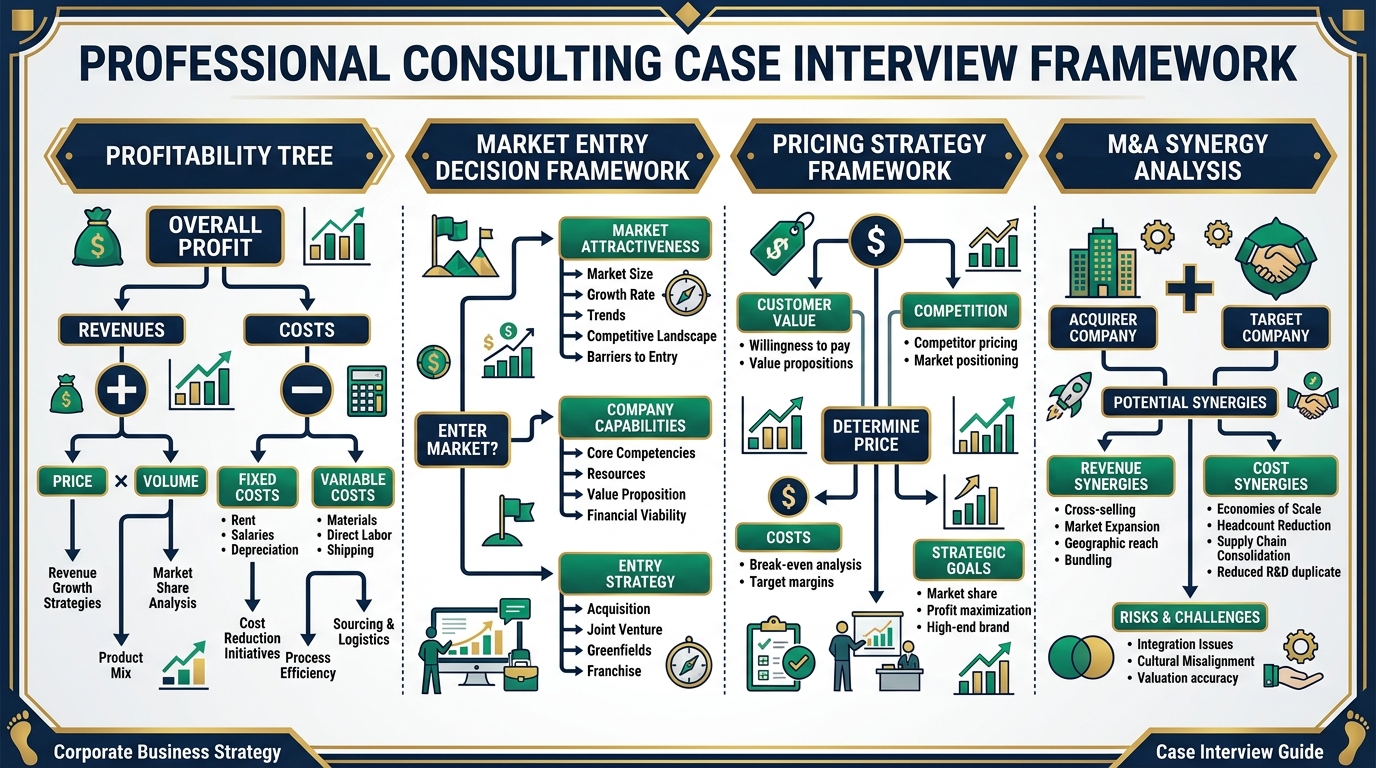
Management Consulting Case Interview Preparation Guide: MBB Frameworks & Guesstimates
What You'll Learn in This Masterclass
Quick Reference Matrix
| Case Archetype | Core Objective | Primary Issue Tree Structure | Key Risks & Qualitative Factors |
|---|---|---|---|
| Profitability | Diagnose profit decline or margin compression | Profit = (Price * Volume) - (Fixed Costs + Variable Costs) | Industry vs company-specific trends, product mix shifts, cost inflation, capacity utilization |
| Market Entry | Assess whether to enter new geography or sector | Market Attractiveness -> Financial Feasibility -> Operational Capability -> Entry Mode | Mode of entry (Organic vs JV vs M&A), regulatory clearances, competitor retaliation, customer CAC |
| Growth Strategy | Identify avenues to achieve aggressive revenue targets | Ansoff Matrix: Market Penetration, Market Development, Product Dev, Diversification | Capital constraints, brand dilution, execution complexity, cannibalization of core products |
| M&A Due Diligence | Evaluate acquisition or merger target | Strategic Rationale -> Financial Valuation -> Synergy Value -> Feasibility / Cultural Fit | Cost vs Revenue synergies, integration timeline, regulatory antitrust scrutiny, cultural friction |
| Pricing Strategy | Determine optimal price for new product/service | Cost-Plus -> Competitive Benchmark -> Value-Based (Willingness to Pay) | Cannibalization, elasticity of demand, customer switching costs, brand positioning |
Phased Execution Roadmap
Phase 1: Foundations, Mental Math & MECE Trees
Internalize the MECE philosophy, basic accounting math, and market sizing calculations.
Phase 2: Core Frameworks & Peer Mock Drilling
Execute live interactive cases with case partners covering the four foundational archetypes.
Phase 3: Advanced Cases, Charts & McKinsey PEI Mastery
Tackle complex, unstructured problems, interpret ambiguous charts, and refine your leadership stories.
Phase 4: Expert Pressure Testing & Polishing
Simulate final-round partner interviews with working consultants or alumni.
Visual Architecture & Process Diagrams
The proven hypothesis-driven framework used by top strategy consultants to diagnose ambiguous business crises.
The MECE Principle & Tailored Issue Tree Structuring
The foundation of all management consulting interviews is MECE: Mutually Exclusive, Collectively Exhaustive.
- Mutually Exclusive: The branches of your issue tree must not overlap. If you analyze a problem under one bucket, the other buckets should not contain that same variable.
- Collectively Exhaustive: Your tree must cover all potential root causes. If the solution lies anywhere in the business, your framework must catch it.
1. Moving Beyond Generic Textbook Frameworks
Junior candidates memorize generic frameworks like the "4Ps" (Product, Price, Place, Promotion) or "3Cs" (Customer, Company, Competition) and force-fit them onto every problem. Top firms immediately deduct points for cookie-cutter frameworks. You must construct a bespoke issue tree tailored to the client’s industry.
Example: If analyzing why a commercial airline's profitability declined:
```text
Profitability = Total Revenue - Total Costs
├── Total Revenue
│ ├── Passenger Revenue = (Available Seat Kilometers Load Factor Yield per Pax-km)
│ ├── Cargo / Freight Revenue = (Tonnage Shipped * Rate per kg)
│ └── Ancillary Revenue = (Baggage Fees + Seat Selection + In-flight Catering)
└── Total Costs
├── Fixed Costs = (Aircraft Lease Payments + Airport Gate Slots + Maintenance Overhaul)
└── Variable Costs = (Aviation Turbine Fuel [ATF] + Flight Crew Wages + Landing Fees)
`
Notice how this tree uses airline-specific metrics (Load Factor, Yield, Seat Kilometers, ATF) rather than generic "Price times Quantity". This immediately signals industry acumen.
Mastering Guesstimates & Market Sizing Calculations
A guesstimate tests your ability to take a massive, ambiguous estimation problem, break it into sensible micro-assumptions, and perform rapid mental math without a calculator.
1. Top-Down (Population Filtering) vs Bottom-Up (Capacity Constraint)
- Top-Down Approach: Best for consumer products (e.g., "Estimate the annual market size of smartphones sold in India").
- Calculation flow: Total Population (1.4 Billion) -> Urban vs Rural split -> Income bracket segmentation (Upper, Middle, Lower) -> Smartphone penetration rate -> Device replacement cycle (e.g., once every 3 years) -> Average Selling Price (ASP).
- Bottom-Up Approach: Best for physical facilities or service constraints (e.g., "Estimate the daily revenue of a bustling Starbucks store in downtown Mumbai").
- Calculation flow: Operating hours (6 AM to 11 PM = 17 hours) -> Peak hours vs Off-peak hours -> Number of cash registers -> Average transaction processing time -> Average Order Value (AOV) -> Multiply by occupancy.
2. The Mental Math Rulebook:
- Round aggressively with stated justification: In India, assume population = 1.4 Billion; average household size = 4 people; life expectancy = 70 years. In the US, assume population = 330 Million; household size = 2.5.
- Use Scientific Powers of 10: Multiply $40 \times 10^6$ by $150 = 6,000 \times 10^6 = 6 \text{ Billion}$. Never scribble trailing zeros that cause careless counting errors.
- Sanity Check: Always compare your final number to macroeconomic realities. If your estimate for shampoo bottles sold exceeds the national GDP, you know an assumption broke.
Executing the 4 Core Case Archetypes
Every consulting problem can be decomposed into variations of four foundational business archetypes:
1. Profitability Case
The client’s profit margin has shrunk.
- Step 1: Benchmark the market. Is the whole industry suffering (macroeconomic/regulatory shock) or is it just our client (company-specific issue)?
- Step 2: Isolate Revenue vs Cost. Drill down the affected branch. If Revenue: is it Price decline or Volume collapse? If Cost: did Fixed overheads balloon or Variable input costs spike?
- Step 3: Segment. Break down by product line, customer geography, and sales channel. Frequently, 80% of the loss originates from a single failing product tier.
2. Market Entry Case
The client wants to enter a new market (e.g., an Indian telecom giant entering African fintech).
- Branch 1: Market Attractiveness: Total Addressable Market (TAM), projected CAGR, customer willingness to pay, and regulatory hurdles.
- Branch 2: Financial Viability: CapEx required, operational cost structure, projected break-even point, and NPV/IRR.
- Branch 3: Operational Capabilities: Supply chain readiness, local talent acquisition, technology stack, and distribution networks.
- Branch 4: Entry Mode: Organic build (slow, full control), Joint Venture (local expertise, profit sharing), or M&A (fast, high capital cost, cultural integration risks).
3. Growth Strategy Case
The client wants to increase revenue from $500M to $1B in 3 years. Use the Ansoff Matrix:
- Existing Products to Existing Customers: Increase share of wallet, cross-selling, loyalty programs.
- Existing Products to New Customers: Geographic expansion, new demographic segments.
- New Products to Existing Customers: Product extensions, premium tiers.
- New Products to New Customers: Full diversification.
4. Pricing Strategy Case
Evaluate pricing across 3 standard methodologies:
- Cost-Plus: Floor price = Cost of production + target margin.
- Competitive Benchmark: Benchmark against direct substitute alternatives.
- Value-Based (WTP): Ceiling price = How much monetary value, cost savings, or emotional utility does this product generate for the customer?
Synthesizing Like a Partner: The Pyramid Principle & PEI Fit
At the end of a 30-minute case, the interviewer will say: "The CEO just stepped into the elevator. Give her your recommendation."
Junior candidates narrate a chronological recap of their math. Senior consultants use the Pyramid Principle: Answer first, followed by supporting pillars, risks, and next steps.
1. The Executive Recommendation Blueprint:
```text
"We recommend that the client [Action] to achieve [Objective] within [Timeframe].
Our recommendation is supported by three primary findings:
- 1First, [Market/Financial justification with specific data points].
- 2Second, [Operational/Competitive advantage].
- 3Third, [Feasibility and economic return].
The primary risks to monitor are [Risk A] and [Risk B].
As immediate next steps, we suggest conducting [Pilot test / Due diligence] within the next 60 days."
`
2. The Personal Experience Interview (PEI) Fit Round
At McKinsey, BCG, and Bain, fit interviews carry equal weight to the case itself. MBB partners ask: "Can I put this person in front of a Fortune 500 CEO on day one?"
- Personal Impact: A story where you persuaded an executive or team who initially opposed your idea, utilizing data and emotional intelligence.
- Entrepreneurial Drive: A story where you spotted an unaddressed problem, took initiative without permission, and built a solution from scratch.
- Inclusive Leadership: A story where you led a diverse or struggling team through a high-pressure deadline, resolving interpersonal conflicts.
High-Frequency Interview Questions & Frameworks
A premier 5-star business hotel chain in Mumbai has seen its net profitability drop by 25% over the past 12 months, despite occupancy rates remaining steady at 85%. How would you diagnose and solve this problem?
Estimate the annual market size of disposable coffee cups consumed at Mumbai International Airport (Chhatrapati Shivaji Maharaj International Airport).
Tell me about a time when you had to persuade a client or senior stakeholder who strongly disagreed with your data-backed recommendations.
Costly Mistakes to Avoid
- ✕Memorizing rigid frameworks and forcing them onto problems where they do not fit.
Correction: Build bespoke issue trees from first principles. If the client is a hospital, your branches must represent beds, surgeries, pharmacy, and insurance claims—not generic 4Ps.
- ✕Silence for extended periods during mathematical computations.
Correction: Keep the interviewer engaged by talking through your arithmetic steps out loud. Consulting is a collaborative dialogue, not a silent written math exam.
- ✕Neglecting the "So What?" after calculating a number.
Correction: A number in isolation is useless. Immediately translate your numerical answer into a strategic business insight: "This means the client needs a 14% market share just to break even, which is unrealistic in a mature market."
- ✕Failing to prepare for the behavioral Personal Experience Interview (PEI) fit questions.
Correction: Candidates who ace the case often get rejected because their PEI stories lack depth, vulnerability, or specific individual contribution. Dedicate 40% of prep time to fit stories.
Key Takeaways
- •Consulting interviews test your problem-solving process, coachability, and intellectual agility—there is rarely a single "correct" answer.
- •Structure is everything: An average answer delivered with pristine MECE logic beats a brilliant intuitive guess delivered in unstructured chaos.
- •Executive presence is evaluated from the first handshake to the final elevator pitch; remain poised, collaborative, and hypothesis-driven.
Final Interview Checklist
- MECE structuring practiced until bespoke issue trees can be drawn within 90 seconds.
- Mental math fluency achieved: Rapid division, percentage conversions, and powers-of-10 operations.
- Guesstimate methodology mastered across both Top-Down (population) and Bottom-Up (capacity) models.
- The 4 core archetypes (Profitability, Market Entry, Growth, Pricing) practiced with at least 30 live cases.
- Chart interpretation skills refined: Extracting primary insights, CAGR, and segment outliers in under 30 seconds.
- Pyramid Principle recommendation elevator pitch memorized (Action -> 3 Pillars -> Risks & Next Steps).
- PEI story bank compiled for Personal Impact, Entrepreneurial Drive, and Inclusive Leadership.
- At least 15 live mock cases completed with rigorous peer partners or MBB alumni.
Frequently Asked Questions (FAQs)
How many mock cases should I practice before MBB interviews?
Most successful candidates practice between 30 and 45 live, interactive mock cases with experienced case partners. Practicing beyond 50 cases often yields diminishing returns and can lead to robotic, scripted responses.
What is the difference between McKinsey, BCG, and Bain case interviews?
McKinsey typically uses an interviewer-led format where the interviewer guides the candidate through structured questions, data exhibits, and brainstorming prompts. BCG and Bain favor candidate-led formats where the candidate is expected to drive the hypothesis, decide which branches of the tree to explore, and navigate the case with minimal prompting.
Is a business or economics background required to crack consulting cases?
No. Top consulting firms hire extensively from engineering, law, medicine, and liberal arts backgrounds. What firms evaluate is structured logic, quantitative numeracy, and intellectual curiosity, all of which can be developed through deliberate practice.
Can I use a calculator during consulting case interviews?
No. All calculations must be performed mentally or on paper. You are expected to manage large numbers, percentage margins, and basic algebra smoothly while speaking out loud.
What should I do if I get completely stuck during a case interview?
Never panic or sit in prolonged silence. Take a breath, refer back to your original issue tree, summarize what you know so far, and state what you need to discover next. You can politely ask: "Based on our analysis of X, that branch did not yield the root cause. I would like to pivot our hypothesis to branch Y—does that sound reasonable?"
What is the McKinsey Personal Experience Interview (PEI)?
The PEI is a 15-20 minute deep-dive interview focusing on a single story from your past. The interviewer will ask probing questions every 30 seconds ("What did you say next?", "How did you feel?", "Why did you make that choice?") to evaluate your personal leadership, resilience, and impact.
How important are business buzzwords in consulting interviews?
Avoid superficial buzzwords like "synergize", "disrupt", or "paradigm shift". Strategy interviewers value clear, plain, and precise business English that directly communicates cause and effect.
How do I balance fixed costs and variable costs in profitability cases?
Fixed costs (rent, executive salaries, equipment depreciation) do not change with production volume, so they are optimized through capacity utilization or footprint consolidation. Variable costs (raw materials, packaging, direct labor, shipping) scale with volume and are optimized through supplier renegotiation, scrap reduction, or process automation.