Finance Interview Questions & Preparation Guide for Freshers and Professionals
What You'll Learn in This Masterclass
Core Financial Valuation Methodologies & Trade-offs
| Valuation Method | Valuation Type | Key Multiples / Formula | Primary Advantages | Key Vulnerability / Limitation |
|---|---|---|---|---|
| Discounted Cash Flow (DCF) | Intrinsic | PV of Free Cash Flows + Terminal Value discounted at WACC | Theoretically sound; reflects operational fundamentals independent of market swings | Highly sensitive to assumptions (Terminal growth rate, WACC, Capex projections) |
| Comparable Company Analysis | Relative | EV/EBITDA, P/E, EV/Sales, Price/Book | Reflects real-time market sentiment and actual trading benchmarks | Market irrationality or bubbles distort valuation; true pure-play peers are rare |
| Precedent Transactions | Relative | EV/EBITDA paid in historical M&A deals | Includes the actual control premium paid by strategic buyers | Historical deals may reflect outdated macroeconomic conditions or bidding wars |
Visual Architecture & Process Diagrams
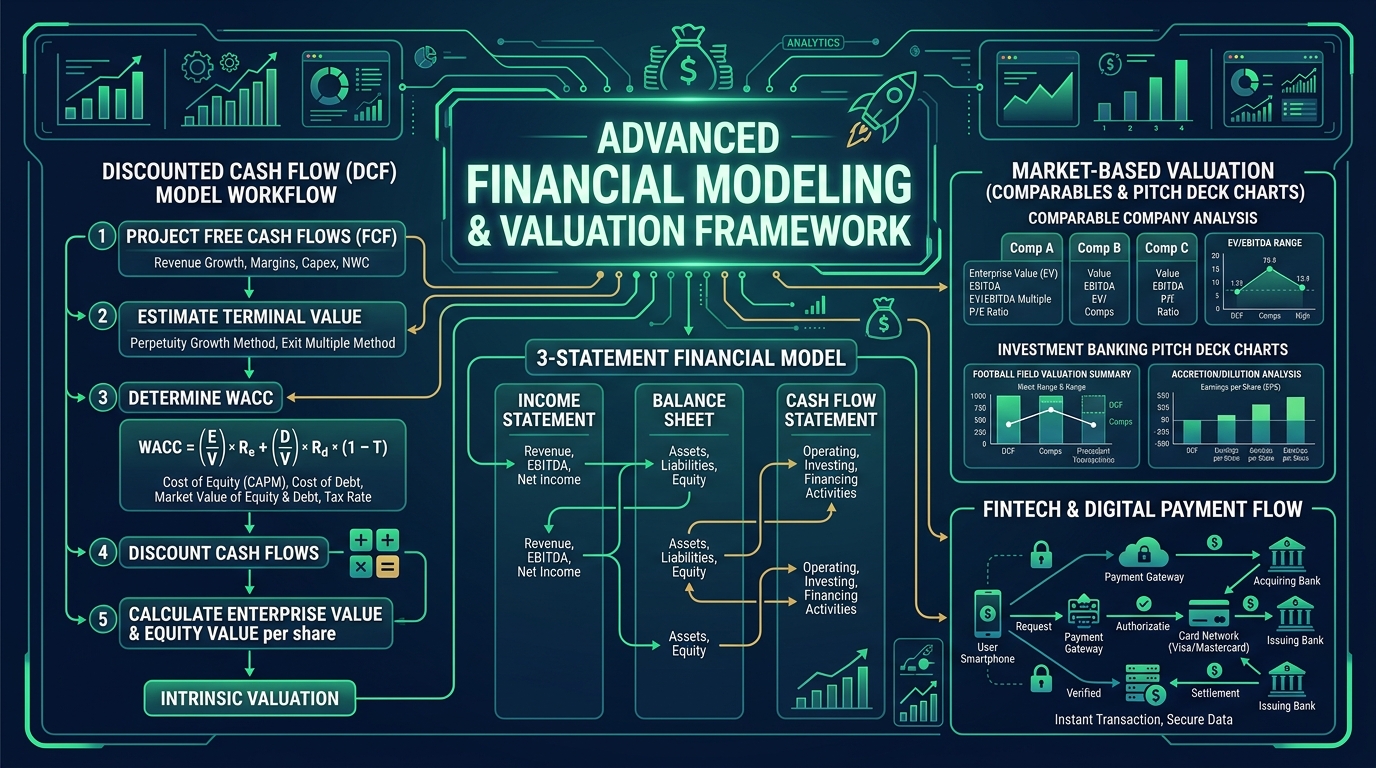
Visualizing how Net Income from the Income Statement flows into the Cash Flow Statement, affecting Cash and Retained Earnings on the Balance Sheet.
1. The Three Financial Statements & Their Linkages
The three financial statements provide a holistic view of a company's financial health:
- 1Income Statement: Reports revenue, expenses, and profitability over a period of time (Net Income).
- 2Balance Sheet: A snapshot of a company's financial position at a single point in time (
Assets = Liabilities + Shareholders' Equity). - 3Cash Flow Statement: Tracks cash inflows and outflows across three activities: Operating (CFO), Investing (CFI), and Financing (CFF).
The Golden Linkages:
- Net Income from the Income Statement forms the starting top line of the Cash Flow Statement under Operating Activities.
- Non-cash expenses (Depreciation & Amortization) are added back on the Cash Flow Statement.
- Net Change in Cash from the bottom of the Cash Flow Statement links directly to the Cash line item under Current Assets on the Balance Sheet.
- Net Income (less dividends paid) flows into Shareholders’ Equity on the Balance Sheet under Retained Earnings.
2. DCF Valuation Mechanics: Free Cash Flows & WACC
A Discounted Cash Flow (DCF) values a business based on the present value of its future cash flows.
Unlevered Free Cash Flow (UFCF) Formula:
UFCF = EBIT * (1 - Tax Rate) + D&A - Capital Expenditures (Capex) - Δ Net Working Capital
Weighted Average Cost of Capital (WACC):
WACC = (E / V) * Re + (D / V) * Rd * (1 - Tax Rate)
Re(Cost of Equity): Calculated via CAPM:Re = Rf + Beta * (Rm - Rf).Rd(Cost of Debt): Pre-tax yield on company debt, adjusted for the corporate interest tax shield(1 - Tax Rate).
3. Enterprise Value vs. Equity Value
- Equity Value (Market Cap): The value of the company attributable strictly to equity shareholders (
Share Price * Fully Diluted Shares Outstanding). - Enterprise Value (TEV): The total value of the company’s core operating assets attributable to all capital providers (equity holders, debt holders, preferred stock holders).
The Bridge Formula:
Enterprise Value = Equity Value + Total Debt + Preferred Stock + Non-Controlling Interests - Cash and Cash Equivalents
(Cash is subtracted because it is a non-operating asset and can be used immediately to pay down debt in an acquisition).
High-Frequency Interview Questions & Frameworks
Walk me through how a $10 increase in depreciation flows through the three financial statements. Assume a 20% corporate tax rate.
Why do we look at both Enterprise Value (EV) and Equity Value? Which valuation multiples pair with which value?
Costly Mistakes to Avoid
- ✕Pairing pre-interest metrics like EBITDA with Equity Value instead of Enterprise Value.
- ✕Subtracting debt instead of adding debt when bridging from Equity Value to Enterprise Value.
- ✕Believing WACC always decreases as more debt is added (debt increases financial distress risk and raises Cost of Equity via beta relevering).
- ✕Confusing Free Cash Flow to Firm (FCFF - unlevered) with Free Cash Flow to Equity (FCFE - levered).
- ✕Treating working capital solely as Current Assets minus Current Liabilities without excluding cash and short-term debt.
Key Takeaways
- •Cash flow is the lifeblood of a business; accounting Net Income can be easily distorted by accruals and non-cash items.
- •Enterprise Value is capital structure neutral, making EV/EBITDA the preferred cross-company comparison multiple.
- •The discount rate (WACC) reflects the blended risk of debt and equity capital providers.
- •In finance interviews, structure, speed, and precision in 3-statement walk-throughs establish instant credibility.
Final Interview Checklist
- Be able to trace the 3-statement impact of changes in inventory, debt issuance, and Capex flawlessly on paper.
- Derive Unlevered Free Cash Flow from EBIT and EBITDA.
- Explain the Gordon Growth Terminal Value formula:
TV = [FCF * (1 + g)] / (WACC - g). - Calculate the Cash Conversion Cycle:
DSO + DIO - DPO. - Know how to un-lever and re-lever Beta using the Hamada equation.
- Prepare to articulate your financial market views and interest rate trends concisely in 2 minutes.
Frequently Asked Questions (FAQs)
What is EBITDA and why is it widely used by finance professionals?
EBITDA stands for Earnings Before Interest, Taxes, Depreciation, and Amortization. It serves as a quick proxy for operating cash flow because it strips out the effects of financing choices (Interest), tax jurisdictions (Taxes), and capital investment age (D&A), enabling fair operational comparisons across companies with different capital structures.
Can a company have positive EBITDA and still go bankrupt?
Yes, absolutely. A company with positive EBITDA can go bankrupt if: 1. Massive interest payments exceed operating profit. 2. Heavy capital expenditures (Capex) exhaust cash reserves. 3. Working capital expansion (uncollected receivables or unsold inventory) traps all liquidity. 4. Debt principal maturities arrive and the company cannot refinance.
What is Net Working Capital (NWC) in financial modeling?
In financial modeling, Operating Net Working Capital is defined as Operating Current Assets (excluding Cash) - Operating Current Liabilities (excluding Short-Term Debt). An increase in NWC represents a cash outflow because money is tied up in inventory or receivables.
What is Beta in the Capital Asset Pricing Model (CAPM)?
Beta (β) measures the systematic, non-diversifiable volatility of a stock relative to the broader market. A Beta of 1.0 indicates the asset moves in lockstep with the market; Beta > 1.0 indicates higher volatility (tech startups); Beta < 1.0 indicates lower volatility (utilities, consumer staples).
Why is Cost of Debt cheaper than Cost of Equity?
Cost of Debt is cheaper because: 1. Debt holders have senior liquidation priority over equity holders if the firm liquidates, meaning lenders bear less risk. 2. Interest payments on debt are tax-deductible in most jurisdictions, creating an interest tax shield that reduces the effective cost of debt to Rd * (1 - Tax Rate).
What is the difference between Goodwill and other Intangibles?
Goodwill is an unamortized intangible asset created during an acquisition when the purchase price exceeds the fair market value of the target’s net identifiable tangible and intangible assets. It reflects brand equity, customer loyalty, and workforce talent, and is tested annually for impairment.
What is the internal rate of return (IRR)?
The Internal Rate of Return (IRR) is the discount rate that makes the Net Present Value (NPV) of all future cash flows from an investment equal to exactly zero. A project is deemed financially acceptable if its IRR exceeds the company’s hurdle rate or cost of capital.
How do you value a company with negative net income?
Use revenue-based multiples (EV/Sales), forward-looking multiples based on projected normalized earnings, Discounted Cash Flow models with a long projection horizon until profitability, or sum-of-the-parts (SOTP) liquidation valuation.
Authoritative References & Standards
The global academic authority on valuation, equity risk premiums, beta calculations, and cost of capital.
The standard Wall Street practitioner manual for 3-statement financial modeling and LBO analysis.