HR Interview Questions and Answers: Complete Preparation Guide for Freshers and Experienced
What You'll Learn in This Masterclass
Quick Reference Matrix
| Question Archetype | Recruiter's Hidden Intent | Winning Strategy & Framework | Fatal Blunder to Avoid |
|---|---|---|---|
| "Tell me about yourself" | Tests verbal communication, clarity of narrative, and self-awareness | Present -> Past -> Future value proposition (90 seconds max) | Reading your chronological resume or sharing childhood hobbies |
| "What is your greatest weakness?" | Tests honesty, self-reflection, and proactive habit reformation | Real professional weakness + concrete corrective system implemented | Fake humblebrags ("I am a perfectionist") or disqualifying fatal flaws |
| "Why do you want to leave your job?" | Evaluates professionalism, workplace attitude, and potential flight risk | Focus on pull factors (growth, new domain) rather than push factors | Complaining about your current manager, company politics, or salary |
| "Where do you see yourself in 5 years?" | Assesses ambition, realistic career planning, and company retention probability | Focus on skill depth, domain mentorship, and expanded organizational impact | Saying "In your seat" or describing an unrelated entrepreneurial dream |
| "What are your salary expectations?" | Anchors compensation range and gauges market awareness | Deflect early; anchor to market benchmarks and total CTC value | Naming a rigid number first or stating "Whatever the company pays" |
Phased Execution Roadmap
Step 1: Self-Audit & The Behavioral Story Repository
Build a catalog of structured professional anecdotes before opening your mouth in an interview.
Step 2: Company Reconnaissance & Cultural Alignment
Research the target employer’s corporate values, leadership philosophy, and operating principles.
Step 3: Compensation Benchmarking & Red-Line Definition
Determine your realistic market compensation and script negotiation scenarios.
Step 4: Mock Simulation & Executive Presence Polishing
Eliminate nervous filler words, refine body language, and perfect your closing questions.
Visual Architecture & Process Diagrams
The holistic psychological and behavioral matrix used by HR leaders to score candidate cultural fit.
Deconstructing the Universal Opener: "Tell Me About Yourself"
Ninety percent of HR interviews open with this deceptively simple prompt. Most candidates stumble by reciting their resume chronologically, reciting their school marks, or summarizing personal hobbies.
HR does not want a summary of your resume—they want to evaluate narrative clarity, self-awareness, and value alignment.
The 90-Second Present-Past-Future Formula:
- 1Present (30 Seconds): State your current professional identity, core area of specialization, and your primary daily impact.
- Example: "Currently, I am a Frontend Engineer at [Company], where I lead our core design system and optimize web performance for over 4 million monthly active users."
- 1Past (30 Seconds): Highlight 1-2 pivotal experiences or projects that built your core technical and problem-solving foundation.
- Example: "Prior to this, I completed my degree in Computer Science, where I built an automated campus recruitment portal and interned at a fintech startup, which sparked my passion for scalable frontend ergonomics."
- 1Future & Fit (30 Seconds): State the exact inflection point that brings you to this interview and connect it directly to this company's open challenge.
- Example: "While I love optimizing interfaces, I am ready to step into a full-scale cloud infrastructure role. When I saw that your team is migrating to a distributed micro-frontend architecture, I recognized it as the exact environment where my rendering optimization skills can drive measurable latency improvements."
Tackling "What is Your Greatest Weakness?" and Sensitive Questions
This question is designed to catch two types of candidates: those who lack self-awareness (saying "I don't really have any weaknesses") and those who use transparent cliches ("I work too hard" or "I'm a perfectionist").
1. The 3-Part Winning Weakness Architecture:
- Part 1: Name a Real, Non-Fatal Professional Skill: Pick a legitimate area of growth that is not a core requirement of the role. (If applying for an Accountant job, do not say you are bad at math; if applying for a Developer job, do not say you hate writing code). Good choices: public speaking anxiety, difficulty delegating early in a project, or getting absorbed in granular optimization at the expense of macro speed.
- Part 2: Acknowledge the Concrete Impact: Explain how you realized this was holding you back.
- Part 3: Detail Your Proactive Corrective System: Detail the tangible habits, courses, or processes you implemented to fix it.
- Winning Sample: "Early in my career, I struggled with delegating tasks to junior colleagues because I felt personally accountable for every line of execution, which created bottlenecks for my team. Recognizing this, I took a project management certification and implemented a structured delegation framework using Notion task boards with weekly check-in milestones. Over the last year, this system has allowed me to empower junior engineers while keeping deliverables on schedule."
2. Explaining Career Gaps and Job Hopping:
- Career Gap: Never apologize defensively. State the facts plainly: "I took a 10-month planned sabbatical to care for a family medical priority / complete a full-time certification in cloud architecture. During that time, I maintained my technical currency by completing 3 production projects on GitHub and passing the AWS Solutions Architect exam. I am fully energized and ready for this next full-time commitment."
- Short Tenure: Frame moves around organizational restructuring or career acceleration: "My previous role was eliminated during a company-wide restructuring after an acquisition. I am seeking a stable, long-term team where I can contribute for the next 4-5 years."
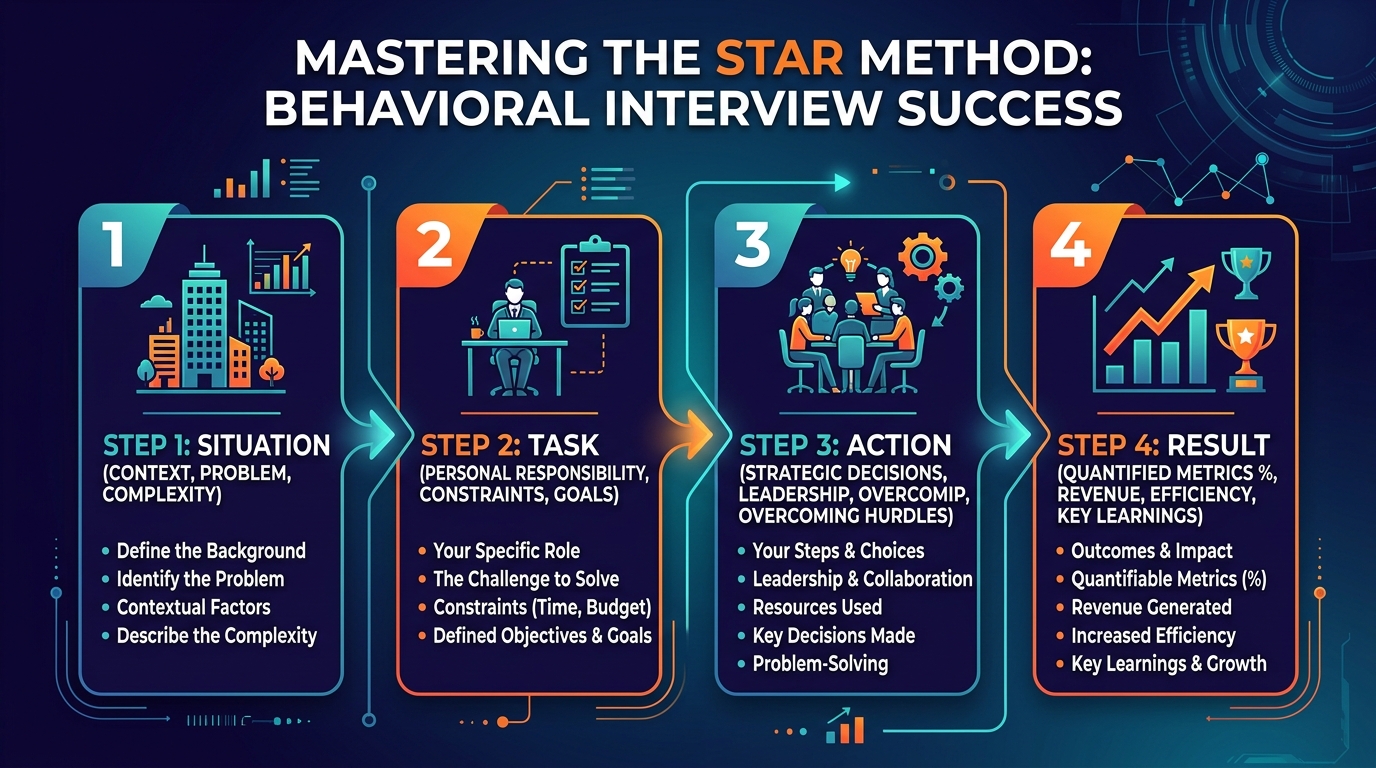
Mastering the Behavioral STAR Method
Whenever an interviewer says: "Tell me about a time when...", "Describe a situation where...", or "Give me an example of...", they are running a behavioral interview. Behavioral interviewing operates on the premise that past behavior is the best predictor of future performance.
The STAR Framework Anatomy:
```text
[S] SITUATION (20% of time)
Set the stage: Company, project scope, business challenge, and timeline constraints.
Keep it concise; avoid unnecessary technical backstories.
[T] TASK (10% of time)
Clarify the specific objective: What was YOUR individual responsibility in this crisis?
[A] ACTION (50% of time) - The Core Evaluation Vector
Detail the concrete steps YOU took. Use "I", not "We".
Explain your logic: "I first organized a 15-minute standup... I then wrote a Python script..."
Highlight interpersonal leadership, technical problem-solving, and emotional resilience.
[R] RESULT (20% of time)
Quantify the outcome: Did revenue increase by 15%? Did latency drop by 200ms?
Share what you learned and how the organization adopted your solution permanently.
`
The Core STAR Story Archetypes Every Candidate Must Prepare:
- 1The High-Pressure Conflict: A time you disagreed with a colleague or manager and resolved it constructively.
- 2The High-Stakes Failure: A time a project missed a deadline or failed in production, and how you took ownership.
- 3The Unsolicited Initiative: A time you spotted an inefficiency that was outside your job description and fixed it.
- 4The Ambiguous Task: A time you were assigned a vague objective with zero documentation and navigated it successfully.
Salary Negotiation & The Final Closing Dynamics
The HR interview is where compensation boundaries are established. The candidate who understands compensation psychology enters negotiations with enormous leverage.
1. Deflecting Premature Salary Requests (The First Rule of Negotiation)
If asked in the initial screening: "What are your salary expectations?", never name a specific number first.
- The Deflection Script: "Right now, my primary focus is finding the right role where I can make a meaningful impact and grow with the team. Once we agree that I am the right technical and cultural fit for this position, I am confident we can arrive at a compensation package that reflects market standards and the value I bring. Could you share the budgeted range for this position?"
2. When Pushed to Provide a Number:
If the recruiter insists: "Our system requires an expected CTC before we can proceed":
- Give a well-researched bracket where your ideal number is at the bottom: "Based on market benchmarks for this seniority level in Bengaluru and my experience scaling distributed systems, I am targeting between Rs. 18 to 22 Lakhs fixed CTC, depending on the overall benefits and ESOP structure."
3. Asking High-Signal Reverse Questions:
When the HR interviewer asks: "Do you have any questions for me?", asking nothing is a disqualifier. Ask questions that demonstrate long-term commitment:
- "How does the team measure success for this role during the first 90 days?"
- "What distinguishes high performers from average contributors in this organization’s culture?"
- "Can you share an example of how the company supported an employee’s professional development recently?"
High-Frequency Interview Questions & Frameworks
Why should we hire you over other qualified candidates who have applied for this position?
Tell me about a time when you strongly disagreed with your manager or team lead. How did you handle the situation?
Where do you see yourself in five years?
Costly Mistakes to Avoid
- ✕Treating the HR interview casually, assuming you have already passed because technical rounds went well.
Correction: HR leaders hold absolute veto power. An arrogant attitude, lack of enthusiasm, or dismissive demeanor will trigger an immediate rejection.
- ✕Using generic, unquantified adjectives ("I am a hardworking, punctual team player") without evidence.
Correction: Show, don’t tell. Support every claim with a concrete STAR story containing quantified outcomes and business impact.
- ✕Revealing your current salary too early or stating a rigid number without understanding market bands.
Correction: Deflect salary discussions until mutual interest is established, and always anchor to comprehensive market compensation benchmarks.
- ✕Failing to ask thoughtful questions when given the floor at the end of the interview.
Correction: Asking zero questions signals disinterest. Prepare 3-4 insightful questions about team dynamics, company culture, and evaluation criteria.
Key Takeaways
- •The HR round evaluates emotional intelligence, cultural alignment, ethics, and long-term retention potential.
- •Past behavior is the best predictor of future performance: master the STAR method to deliver structured, high-impact answers.
- •Negotiate with market data, professional composure, and total rewards perspective rather than emotional demands.
Final Interview Checklist
- 90-second "Tell me about yourself" elevator pitch rehearsed and timed.
- STAR story bank compiled for leadership, failure, interpersonal conflict, and ambiguous challenges.
- Weakness identified with a concrete, proactive improvement system actively running.
- Market salary range researched on Levels.fyi and Glassdoor for your specific role and city.
- Target company values, mission statement, recent news, and product challenges memorized.
- Salary deflection scripts and counter-offer negotiation boundaries defined.
- Career gaps or short tenures framed with professional, forward-looking ownership.
- 4 high-signal reverse questions prepared to evaluate team psychological safety and culture.
Frequently Asked Questions (FAQs)
What is the main objective of an HR interview round?
The HR round evaluates cultural fit, interpersonal communication, emotional stability, professional ethics, salary expectations, and potential red flags (such as badmouthing employers or lack of accountability). It ensures you will be a cohesive, reliable addition to the team.
How do I answer "What are your salary expectations?" if I am a fresher?
As a fresher, respond: "As a fresh graduate, my primary focus is to join an innovative organization where I can apply my skills, learn from experienced mentors, and contribute to real-world projects. I am confident that the company offers competitive compensation aligned with industry standards for entry-level roles, and I am open to standard company pay bands."
How should I explain a gap year on my resume during an HR interview?
Be completely honest, concise, and forward-looking. State the reason clearly (exam preparation, caring for family, health recovery, or skill upgradation) and emphasize the productive activities, certifications, and discipline you maintained during the period.
Can an HR round reject you even if technical interviews were excellent?
Yes. HR managers possess veto power and frequently reject candidates who demonstrate arrogance, poor communication, cultural mismatch, dishonesty regarding credentials or notice period, or unrealistic compensation demands.
What should I wear to an HR interview?
For formal corporate environments (banking, consulting, manufacturing): full business formal attire (suit or formal shirt/trousers, formal saree/salwar). For tech startups and software firms: smart business casuals (crisp collared shirt, chinos/trousers, formal footwear). Always err on the side of being slightly overdressed.
How do I answer "Why are you looking for a job change after only 6 months?"
Focus on growth and domain alignment rather than dissatisfaction. Explain that while you learned valuable fundamentals, the scope of the role unexpectedly shifted away from your core strengths or that a company restructuring altered the project trajectory, making this new opportunity the ideal long-term fit.
Is it acceptable to negotiate salary after receiving a job offer letter?
Yes, negotiating an initial offer is standard industry practice. Express deep gratitude and excitement for the offer, highlight your specific value and market benchmarks, and politely ask if there is flexibility within the budget to bridge the gap toward your target CTC.
How do I respond if an HR asks "Do you have any other job offers?"
Answer honestly without being boastful. If you have active offers, say: "Yes, I am in final discussions with another firm, but this role and company remain my top preference due to [specific reason]." If you do not have other offers, say: "I am actively interviewing with a few select organizations that match my career goals, but this opportunity is currently my primary focus."