AI & Machine Learning Engineer Interview Guide: Complete Preparation Roadmap
What You'll Learn in This Masterclass
Modern AI/ML Engineering Tech Stack (2026 Standards)
| Domain Layer | Industry Technologies | Core Engineering Competencies | Interview Passing Benchmark |
|---|---|---|---|
| Model Architecture | PyTorch, JAX, Hugging Face | Custom tensor operations, gradient accumulation, distributed DDP/FSDP | Explaining Transformer Query-Key-Value projection matrices without hesitation |
| Vector & Retrieval | Pinecone, Qdrant, Milvus, pgvector | HNSW indexing, cosine vs dot product distance, hybrid retrieval | Designing chunking strategies and reranking pipelines that minimize hallucinations |
| Inference & Serving | vLLM, Triton Inference Server, Ollama | Continuous batching, PagedAttention, speculative decoding, quantization | Explaining memory savings of KV cache optimization during generative decoding |
| Fine-Tuning / Post-Training | LoRA, QLoRA, Axolotl, Unsloth | Low-rank adaptation matrices, adapter merging, learning rate schedulers | Explaining why LoRA trains rank decomposition matrices A and B instead of full weights |
| MLOps & Monitoring | Kubeflow, MLflow, Evidently AI, BentoML | Data drift (KS test), concept drift (PSI), model latency SLA tracking | Designing rollback triggers and automated shadow deployment pipelines for ML models |
Visual Architecture & Process Diagrams
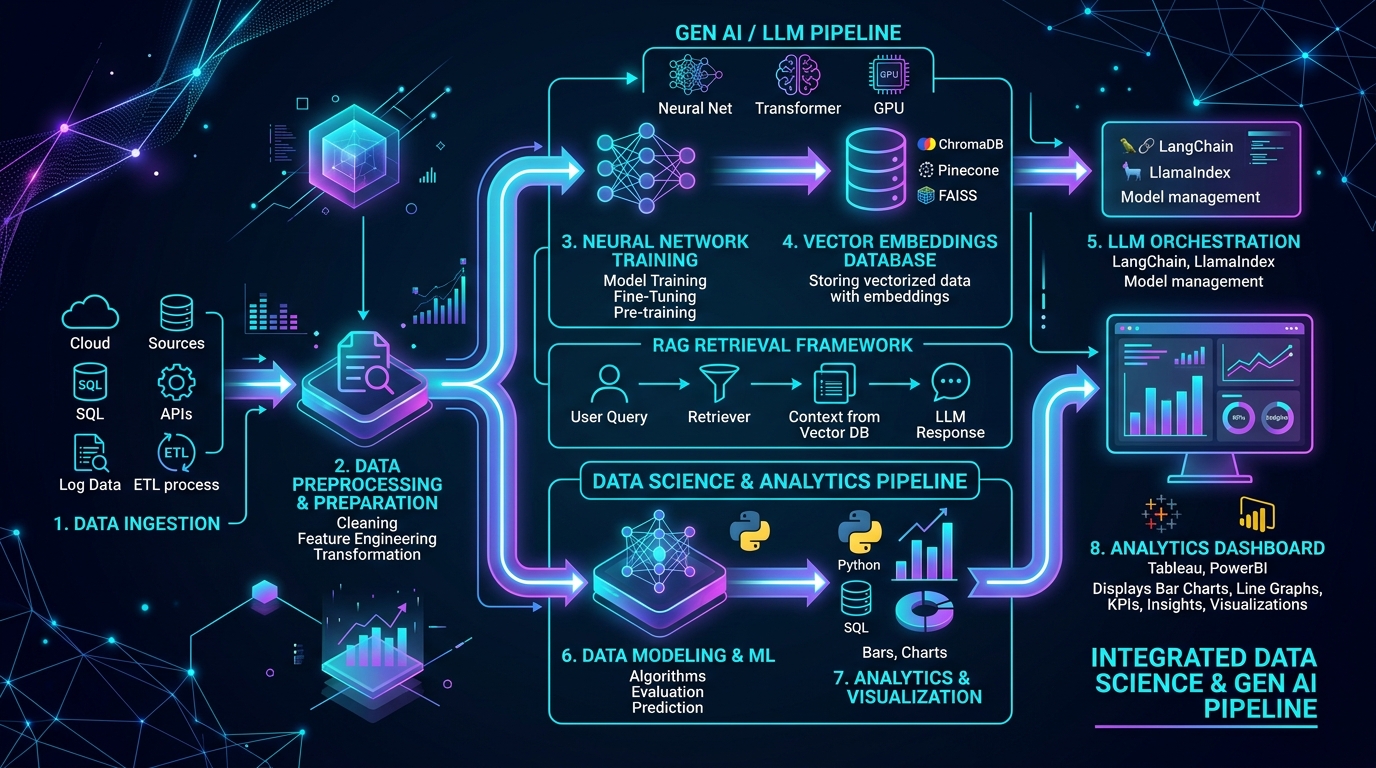
End-to-end architecture of an enterprise Generative AI system: Document ingestion, hybrid vector retrieval, cross-encoder reranking, and low-latency streaming LLM serving.
1. Transformer Architecture & Scaled Dot-Product Attention
The foundation of modern natural language processing and multimodal AI is the Transformer architecture introduced in "Attention Is All You Need" (Vaswani et al.).
Scaled Dot-Product Attention Formula:
Attention(Q, K, V) = softmax((Q * K^T) / sqrt(d_k)) * V
- Query (Q): Represents what the current token is seeking.
- Key (K): Represents what other tokens offer to be matched against.
- Value (V): The actual semantic information extracted if a match occurs.
- Scaling by `sqrt(d_k)`: Critical mathematical step. For large projection dimensions
d_k, dot products grow large in magnitude, pushing thesoftmaxfunction into regions with near-zero gradients (vanishing gradient problem). Dividing bysqrt(d_k)stabilizes variance back to 1.0.
2. Enterprise RAG Systems: Chunking, Vector Indexes & Hybrid Search
Retrieval-Augmented Generation (RAG) grounds LLM responses in proprietary external knowledge bases, mitigating hallucinations and eliminating the continuous expense of model retraining.
Production RAG Best Practices:
- 1Chunking Strategies: Fixed character chunks break semantic coherence. Production systems use Semantic Chunking (splitting on document headings or embedding distance transitions) or Parent-Document Retrieval (searching small 200-token chunks but feeding the parent 1,000-token context to the LLM).
- 2Hybrid Search (Dense + Sparse): Dense embeddings excel at semantic paraphrasing, but fail on exact part numbers, product SKUs, and specific names. Combine Dense Vector search with BM25 keyword search using Reciprocal Rank Fusion (RRF).
- 3Cross-Encoder Reranking: Bi-encoder vector search is fast (sub-10ms) but approximates relevance. Passing the top 50 retrieved chunks through a cross-encoder model (e.g., Cohere Rerank or BGE-Reranker) scores query-document pairs simultaneously, selecting the top 5 most relevant contexts with 90%+ precision.
3. LLM Inference Optimization: KV Caching, PagedAttention & vLLM
In autoregressive generation, each new token requires recomputing attention over all prior tokens. Re-evaluating past tokens naively causes quadratic O(N^2) compute waste.
The KV Cache & PagedAttention
- Key-Value (KV) Cache: Caches the Key and Value matrices of all previous tokens in GPU VRAM, reducing per-token generation to linear matrix-vector multiplication.
- Memory Bottleneck: Storing KV caches across concurrent requests consumes gigabytes of VRAM. Standard memory allocators suffer from external and internal memory fragmentation.
- PagedAttention (vLLM): Inspired by virtual memory paging in operating systems, PagedAttention divides the KV cache into fixed-size physical memory blocks, eliminating memory fragmentation and boosting GPU serving throughput by 2x to 4x.
High-Frequency Interview Questions & Frameworks
Explain how LoRA (Low-Rank Adaptation) works for fine-tuning Large Language Models. Why does it require significantly less GPU VRAM than full fine-tuning?
ΔW = B * A, where W is (d x k), B is (d x r), and A is (r x k) with r << min(d, k). 4. Memory advantage: Pretrained weights are frozen; gradients and optimizer states are computed strictly for matrices A and B.W = W_0 + (alpha / r) * (B * A). Here, matrix A (r x k) is initialized from a Gaussian distribution, and matrix B (d x r) is initialized to zero, ensuring ΔW starts at zero. If d = 4096 and rank r = 8, we reduce the trainable parameters for that layer from 16.7 million down to just 65,536 (a 99.6% reduction). This allows fine-tuning massive foundation models on a single consumer GPU without optimizer state bloat. At deployment, B*A can be mathematically merged into W_0 with zero added inference latency.How do you detect and mitigate hallucinations in a production enterprise RAG system?
Costly Mistakes to Avoid
- ✕Treating LLMs as magical black boxes without understanding attention matrix math and KV cache bottlenecks.
- ✕Using basic vector similarity search without a Cross-Encoder reranker on enterprise RAG systems.
- ✕Fine-tuning foundation models when prompt engineering or retrieval grounding would have solved the problem at 1/100th the cost.
- ✕Ignoring Data Drift (Covariate Shift) and Concept Drift after deploying predictive models to production.
- ✕Deploying high-latency Python-native model servers instead of optimized C++ inference engines (vLLM, Triton).
Key Takeaways
- •Modern AI engineering is 80% systems engineering: data pipelines, vector indices, and low-latency serving.
- •Attention enables dynamic context weighting, but KV caching makes autoregressive decoding computationally viable.
- •RAG is the primary enterprise pattern for grounding foundation models in proprietary real-time knowledge.
- •Always measure Faithfulness and Context Precision before releasing GenAI applications to users.
Final Interview Checklist
- Be able to derive the Scaled Dot-Product Attention formula on a whiteboard and explain sqrt(d_k) scaling.
- Understand positional encodings: Sinusoidal vs Rotary Position Embeddings (RoPE).
- Know how to design a hybrid search pipeline combining Dense embeddings with BM25 sparse vectors via RRF.
- Understand Parameter-Efficient Fine-Tuning: LoRA, QLoRA, and Prefix Tuning.
- Explain PagedAttention and continuous batching in vLLM.
- Know statistical drift metrics: Population Stability Index (PSI) and Kolmogorov-Smirnov (KS) test.
Frequently Asked Questions (FAQs)
What is the difference between Data Drift and Concept Drift?
Data Drift (Covariate Shift) occurs when the input feature distribution P(X) changes over time while the conditional probability P(Y|X) remains constant (e.g., users buying newer phone models). Concept Drift occurs when the statistical relationship between input features and target labels changes (P(Y|X) changes, e.g., consumer spending behavior abruptly shifting during high inflation).
What is the difference between pre-training, fine-tuning, and RAG?
Pre-training trains a model from scratch on trillions of tokens to learn language grammar and broad world knowledge (costs millions of dollars). Fine-tuning adapts an existing pre-trained model on specialized domain data to learn specific styles, tones, or instruction formats. RAG dynamically retrieves external documents at query time and injects them into the prompt, providing up-to-date factual grounding without retraining.
How does quantization reduce model memory footprint?
Quantization converts floating-point weights from high precision (FP32 or FP16) to lower-bit representations (INT8, FP8, or INT4). For example, 4-bit AWQ (Activation-aware Weight Quantization) reduces a 70B parameter model from ~140GB VRAM to ~40GB, allowing it to fit on a single GPU with negligible accuracy loss.
What is the vanishing gradient problem in deep learning and how was it solved?
In deep neural networks, gradients are multiplied by layer weights during backpropagation. With saturating activations (like sigmoid or tanh), gradients shrink exponentially toward zero at earlier layers, halting learning. Solved by using non-saturating activations (ReLU, GELU), residual skip connections (ResNet), and layer normalization.
What is HNSW in vector databases?
Hierarchical Navigable Small World (HNSW) is a state-of-the-art graph-based algorithm for Approximate Nearest Neighbor (ANN) search. It organizes vectors into a multi-layer graph where upper layers have sparse, long-distance skip links (like skip-lists) and the bottom layer contains dense local connections, achieving logarithmic O(log N) search times.
What is the difference between an encoder-only, decoder-only, and encoder-decoder model?
Encoder-only models (BERT) use bidirectional attention, ideal for classification and embedding extraction. Decoder-only models (GPT, Llama, Claude) use causal masked attention (tokens only attend to past tokens), optimal for autoregressive text generation. Encoder-decoder models (T5) encode full input bidirectionally and generate output autoregressively, used in translation and summarization.
What is Speculative Decoding in LLM inference?
Speculative Decoding uses a tiny, fast "draft model" to quickly speculate K candidate tokens in parallel, and then uses the large target LLM to verify all K tokens in a single forward pass. It accelerates generation latency by 2x to 3x without changing the final output distribution.
What is RLHF vs DPO in model alignment?
Reinforcement Learning from Human Feedback (RLHF) trains a separate Reward Model on human preference pairs, and then optimizes the LLM via PPO reinforcement learning. Direct Preference Optimization (DPO) mathematically reparameterizes the objective to train the LLM directly on preference pairs using binary cross-entropy, eliminating the unstable reinforcement learning phase.