Placement Aptitude Preparation: Complete Quantitative, Logical & Verbal Reasoning Guide
What You'll Learn in This Masterclass
Quick Reference Matrix
| Aptitude Domain | High-Frequency Topics | Traditional Bottleneck | Winning Speed Shortcut / Heuristic |
|---|---|---|---|
| Quantitative: Work & Time | Individual work, Alternate days, Pipes & Cisterns, Wages | Solving fractions: 1/x + 1/y = 1/T | LCM Method: Assume total work = LCM of days; assign unit efficiency per day |
| Quantitative: Speed & Distance | Trains crossing poles/platforms, Boats & Streams, Races | Conversions: km/hr to m/s, setting up equations | Multiply by 5/18; for relative speed: add in opposite directions, subtract in same direction |
| Quantitative: Numbers & Percents | Divisibility, Remainder theorem, Profit & Loss, Successive % | Long-form algebraic variable expansion ($100x$) | Use Successive Formula: $a + b + \frac{ab}{100}$; use digital root for large products |
| Logical: Deductive Reasoning | Syllogisms, Statement-Assumption, Cause & Effect | Venn diagram overlapping confusion | Tick-Cross distribution rules or strict Euler circle boundaries; avoid assumptions |
| Logical: Seating Arrangements | Circular (inward/outward), Floor-Flat, Parallel rows | Restarting entire puzzle when one branch fails | Maintain two parallel possibility matrices from clue #1 to eliminate contradictions |
| Verbal: Grammar & Reading | Error spotting, Cloze test, Para-jumbles, Comprehension | Reading entire 600-word passage line-by-line | Question-first skimming; spot grammatical transitions (However, Although, Therefore) |
Phased Execution Roadmap
Month 1: Speed Arithmetic & Core Quantitative Foundations
Eradicate slow pencil-and-paper arithmetic; build mental math reflex.
Month 2: Advanced Quant & Data Interpretation
Tackle high-weightage arithmetic chapters and graphical data extraction.
Month 3: Logical Reasoning & Analytical Puzzles
Master puzzle grids, blood relations, and formal deductive logic.
Month 4: Verbal Ability & Full-Length Assessment Drills
Refine reading comprehension speed, grammar rules, and complete timed mock tests.
Visual Architecture & Process Diagrams
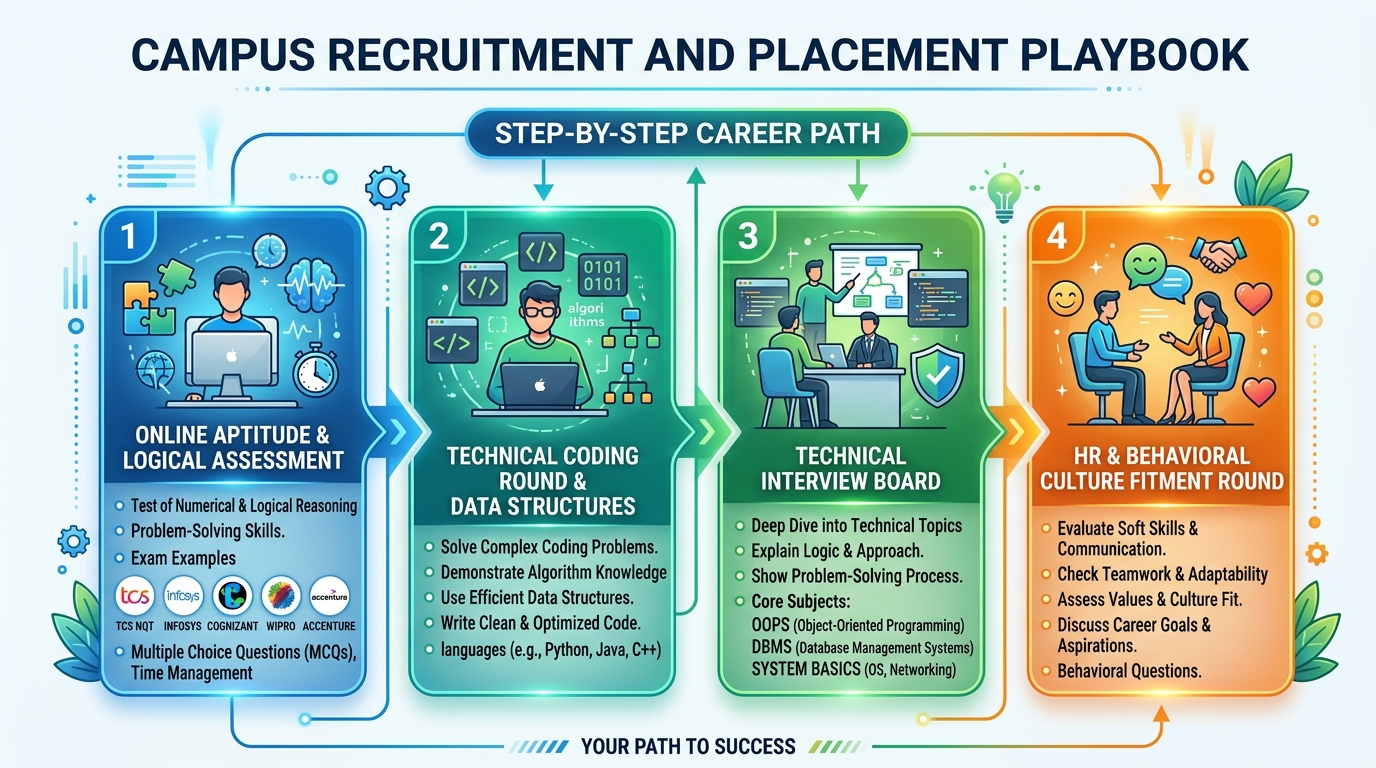
Comprehensive architecture of the three evaluation domains and their underlying speed-math accelerators.
Quantitative Speed Hacks: The LCM & Successive Percentage Models
Standard high school math uses algebraic variables ($x, y$) that require 2-3 minutes of calculations. In campus aptitude tests, you have an average of 45-60 seconds per question. You must use arithmetic shortcuts.
1. The LCM Method for Work & Time (The Ultimate Shortcut)
Problem: Person A can finish a job in 15 days, Person B in 20 days, and Person C in 30 days. They all work together for 2 days, after which A leaves. How long will B and C take to finish the remaining work?
- Step 1: Determine Total Units of Work: Total Work = $\text{LCM}(15, 20, 30) = 60 \text{ units}$.
- Step 2: Calculate Individual Daily Efficiency:
- A's rate = $60 / 15 = 4 \text{ units/day}$.
- B's rate = $60 / 20 = 3 \text{ units/day}$.
- C's rate = $60 / 30 = 2 \text{ units/day}$.
- Combined rate (A + B + C) = $4 + 3 + 2 = 9 \text{ units/day}$.
- Step 3: Calculate Work Done & Remaining:
- In 2 days, together they complete $2 \times 9 = 18 \text{ units}$.
- Remaining work = $60 - 18 = 42 \text{ units}$.
- Step 4: Solve for Remaining Workers (B + C):
- Rate of (B + C) = $3 + 2 = 5 \text{ units/day}$.
- Time required = $\frac{42}{5} = 8.4 \text{ days}$ (or 8 days and 9.6 hours).
Total calculation time: 25 seconds without writing a single fraction.
2. The Successive Percentage Formula ($a + b + \frac{ab}{100}$)
Whenever a quantity undergoes two consecutive percentage changes:
$$\text{Net \% Change} = a + b + \frac{a \times b}{100}$$
(Remember to use negative signs for decreases or discounts).
- Example: A merchant marks up goods by 30% ($a = +30$) and then offers a festival discount of 20% ($b = -20$). What is his net profit or loss?
$$\text{Net \%} = (+30) + (-20) + \frac{(+30)(-20)}{100} = 10 - 6 = +4\% \text{ Profit.}$$
Zero scratch paper calculations needed.
Logical Reasoning: Mastering Seating Puzzles & Syllogisms
Logical reasoning tests your ability to parse conditional constraints without drawing invalid assumptions.
1. Seating Arrangements: The Dual-Matrix Technique
When solving an 8-person circular table where some face the center and some face outward:
- Never guess orientation: Draw two parallel circular diagrams side-by-side from the very first ambiguous clue (Case 1 where Person X faces In, Case 2 where Person X faces Out).
- As you read subsequent clues, populate both diagrams simultaneously.
- Inevitably, one case will produce an impossible contradiction (e.g., placing two people in the same chair), leaving the second case as the valid layout.
- This guarantees you never have to erase and restart your work.
2. Syllogisms: Decoding "Only a Few" and "Possibility"
Modern campus exams (TCS NQT, Infosys) have moved away from simple "All A are B" questions:
- "Only a few A are B": Means two things simultaneously:
- 1Some A are B (Definite true).
- 2Some A are NOT B (Definite true).
- Consequently, the conclusion "All A being B is a possibility" is strictly false.
- "All A being B is a possibility": This is valid if no negative statement directly forbids the overlap.
Verbal Ability: High-Speed Grammar & Reading Comprehension
Verbal ability sections are designed to test your communication baseline and grammatical precision under severe time constraints.
1. The 3 Most Tested Grammatical Traps in Campus Drives:
- 1Subject-Verb Agreement with Intervening Phrases:
- Incorrect: "The quality of these mangoes were not good."
- Correct: "The quality of these mangoes was not good." (The subject is the singular noun quality, not plural mangoes).
- Words like together with, along with, as well as, in addition to do not alter the number of the subject.
- 1Dangling Modifiers:
- Incorrect: "Walking down the street, the trees looked beautiful." (Grammatically implies the trees were walking down the street).
- Correct: "Walking down the street, I thought the trees looked beautiful."
- 1Neither/Nor and Either/Or:
- The verb agrees with the closest subject: "Neither the manager nor the employees were present", but "Neither the employees nor the manager was present."
2. Reading Comprehension (RC) Skimming Strategy:
- Read the Questions First: Before reading a 400-word passage, read the 3-4 associated questions and note the keywords (names, dates, core concepts).
- Topic Sentences: Focus on the first and last sentence of each paragraph. In 90% of business and technical passages, the central thesis resides in these terminal sentences.
Company-Specific Aptitude Patterns (TCS, Infosys, Cognizant, AMCAT)
Each hiring company and testing vendor has a distinct aptitude personality and difficulty calibration.
1. TCS NQT (National Qualifier Test):
- Vendor: TCS iON.
- Characteristics: Sectional timing is strictly enforced; you cannot navigate between sections. No negative marking, but adaptive scoring means early questions carry higher weight.
- Heavy Emphasis On: Number systems (Remainders, Factorials, LCM/HCF), Statistics (Mean, Median, Standard Deviation), and Mensuration.
2. Infosys (Springboard / On-Campus):
- Characteristics: Highly analytical and puzzle-oriented. Questions test mathematical creativity rather than simple formula substitution.
- Heavy Emphasis On: Cryptarithmetic (alphametic puzzles where letters represent digits), visual reasoning grids, critical reasoning, and advanced data sufficiency.
3. Cognizant & Wipro (AMCAT / CoCubes Pattern):
- Characteristics: Fast-paced speed aptitude. Lower mathematical complexity, but requires high calculation velocity.
- Heavy Emphasis On: Profit & Loss, Percentages, Syllogisms, Cloze tests, and basic Data Interpretation.
High-Frequency Interview Questions & Frameworks
A can complete a piece of work in 12 days, and B can complete the same work in 18 days. If they work on alternate days starting with A on Day 1, how many days will it take to finish the work?
A dishonest dealer professes to sell sugar at his cost price, but uses a false weight of 900 grams instead of a true 1-kilogram weight. What is his exact percentage profit?
Evaluate the validity of these conclusions: Statements: 1) All laptops are screens; 2) No screen is a printer; 3) Some printers are keyboards. Conclusions: I) No laptop is a printer; II) Some screens are keyboards.
Costly Mistakes to Avoid
- ✕Using school-level algebraic equations ($x, y$) for Time & Work or Speed problems.
Correction: Use the LCM efficiency model and relative speed multipliers to solve questions in under 30 seconds.
- ✕Spending more than 90 seconds stuck on a single difficult puzzle or arithmetic question.
Correction: Aptitude tests are time-gated. If you cannot crack a question in 45 seconds, mark an educated guess (if no negative marking) and move on immediately.
- ✕Neglecting verbal ability grammar rules, assuming English can be passed by intuition alone.
Correction: Grammar questions in placement drives test specific rules (subject-verb agreement, modifiers, parallelism). Study the top 50 grammatical rules systematically.
- ✕Failing to practice on a physical desktop monitor with an on-screen timer.
Correction: Reading questions from a book is very different from managing on-screen countdown clocks and digital scratch pads. Practice with realistic software simulations.
Key Takeaways
- •Aptitude tests are time-gated elimination trials: speed, mental shortcuts, and tactical question selection matter more than theoretical derivations.
- •The LCM method transforms complex Time & Work fractions into simple, rapid integer additions.
- •Consistency over intensity: 45 minutes of daily timed aptitude practice over 3 months yields vastly superior retention compared to last-minute cramming.
Final Interview Checklist
- Speed Math: Tables up to 25, squares up to 40, and fraction-percentage conversions memorized.
- LCM Work-Efficiency model mastered for individual, alternate-day, and pipe leak problems.
- Speed-Distance relative velocity (trains, boats, circular tracks) formulas consolidated.
- Profit & Loss markup, successive percentages ($a + b + ab/100$), and dishonest seller rules revised.
- Logical Puzzles: Dual-matrix seating arrangement layout practiced.
- Syllogisms: "Only a few", "Some not", and "Possibility" rules internalized.
- Verbal Ability: Top 50 grammar rules (Subject-verb, modifiers, either/nor) reviewed.
- At least 10 full-length company-specific timed mock tests completed.
Frequently Asked Questions (FAQs)
How much time should I dedicate daily to placement aptitude preparation?
Dedicating 45 to 60 minutes daily over a 3-month period is the optimal schedule. Spend 25 minutes on Quantitative arithmetic, 15 minutes on Logical reasoning, and 15 minutes on Verbal grammar rules and mock drills.
Is there negative marking in campus placement aptitude tests?
It depends on the company. TCS NQT generally does not have negative marking, but employs adaptive scoring where incorrect answers penalize your score trajectory. In contrast, tests by AMCAT, CoCubes, and certain product companies often impose a -0.25 penalty for wrong answers. Always read test instructions carefully.
What are Cryptarithmetic questions, and where are they asked?
Cryptarithmetic (or alphametic) questions are mathematical puzzles where arithmetic operations are written with letters replacing digits (e.g., $SEND + MORE = MONEY$). They are a hallmark of the Infosys on-campus test. Solving them requires understanding place values, carry-over limits (sum of two single digits cannot carry more than 1), and parity rules.
What is the fastest way to calculate squares of numbers ending in 5?
Multiply the preceding digits by the next consecutive integer and append 25. For example, for $75^2$: multiply 7 by (7 + 1) = 56, append 25 -> 5625. For $115^2$: multiply 11 by 12 = 132, append 25 -> 13225.
How do you solve Syllogisms without confusing overlapping circles?
Use strict Euler circles or the tick-cross method. Treat negative statements ("No A is B") as impenetrable walls that prevent any overlap between the sets. If a conclusion is not guaranteed in every possible valid diagram, mark it false.
How should I prepare for Reading Comprehension in placement exams?
Always read the questions and keywords before reading the passage. Train yourself to skim: focus on the first and last sentences of paragraphs, and skip descriptive adjectives. Practice reading editorial articles from The Indian Express or Mint to build reading speed.
What is Data Sufficiency in placement aptitude?
Data Sufficiency presents a question followed by two statements (Statement 1 and Statement 2). You are not required to calculate the final numerical answer; you only need to determine whether Statement 1 alone, Statement 2 alone, both combined, or neither is sufficient to uniquely answer the question.
Which book is best for placement aptitude preparation?
Quantitative Aptitude for Competitive Examinations by R.S. Aggarwal remains the foundational standard. For advanced analytical and logical reasoning, A Modern Approach to Verbal & Non-Verbal Reasoning (R.S. Aggarwal) and Arun Sharma’s How to Prepare for Quantitative Aptitude for CAT are widely recommended.